Announcement

Democracy Fund Welcomes New Leaders to its Board and Staff

March 19, 2025

Our people are at the core of living our mission every day — and we are excited to announce a new member of our board of directors along with several internal promotions at Democracy Fund.

We are honored to welcome Vanita Gupta to our board of directors this month. Vanita is currently a Distinguished Scholar in Residence at NYU School of Law. From 2021 – 2024 she served as the 19th Associate Attorney General of the United States at the Department of Justice and previously led the Leadership Conference on Civil and Human Rights. Vanita fills a vacancy created by the departure of board member Danielle Allen, who completed her two-year term earlier this year.

Democracy Fund also has several exciting internal transitions and promotions to share. 

Sanjiv Rao, former managing director of media and movements, has stepped into a newly-created Vice President role as part of Democracy Fund’s executive leadership team. In this role, he will oversee our program, communications, research, partnerships, and strategy functions promoting deeper collaboration across the organization. Before joining Democracy Fund in 2023, Sanjiv served as a senior equity fellow in the Office of Management Budget in the Executive Office of the President. Before that, he completed a nearly decade-long program term at the Ford Foundation, concluding as director of the Civic Engagement and Government program. We are thrilled to welcome him into this new role. 

Josh Stearns, former senior director of Democracy Fund’s Public Square team, has stepped into a new Managing Director of Programs role. In this role, he will run Democracy Fund’s programs in Equitable Journalism, Digital Democracy, Governance, Just & Inclusive Society, and Elections & Voting. Josh has been with Democracy Fund since 2016, leading the efforts of the Public Square team in remaking local journalism and advocating for more just technology. While in his role as senior director, Josh was critical in launching NewsMatch, the largest ever grassroots funding campaign for journalism which has mobilized more than $400M from small donors and foundations, and Press Forward, a national movement to strengthen our democracy by revitalizing local news and information. Before joining Democracy Fund, Josh served as the Director of Journalism and Sustainability at the Geraldine R. Dodge Foundation and Director of Press Freedom at Free Press. 

Angelica Das, former associate director of Democracy Fund’s Public Square team, has been promoted to Program Director for Equitable Journalism. She will co-lead the Public Square team together with Paul Waters, Program Director for Digital Democracy. Angelica has been with Democracy Fund since 2019, where she has led the foundation’s Engaged and Equitable Journalism efforts to make journalism more responsive to and reflective of its communities. At the foundation she has led cutting edge research on media and elections and racial justice and journalism. Previously, she worked as a consultant and Senior Associate with Dot Connector Studio, a production company that collaborates with funders, journalists, and experts to research and develop social impact media. She also served as associate director at the Center for Media & Social Impact at American University. 

Finally, we want to thank Lara Flint, former Managing Director of Elections and Institutions, for her leadership. Lara departed Democracy Fund in February after eight years with the organization. We thank Lara for her many years of dedication to Democracy Fund, and wish her well on her next chapter. 

As an organization, we are only as strong as the team we have to face the challenges and opportunities ahead. We are excited about these changes, and are confident these leaders will help chart the path forward as we work to build an inclusive, multiracial democracy that is open, just, resilient, and trustworthy.

Statement

Democracy Fund Statement on the Passing of Common Cause President Karen Hobert Flynn

March 7, 2023

Democracy Fund mourns the loss of Common Cause President Karen Hobert Flynn. Her role as a staunch democracy defender over the past four decades and her commitment to achieving an American democracy that is inclusive and equitable for all made her a key partner to Democracy Fund since its inception.

While her absence will be painful to bear, Karen will continue to inspire us daily in our work. In our country’s toughest moments, she was not deterred from her vision and wholeheartedly supported her colleagues and partners in the pro-democracy field each step of the way.

We are grateful for Karen’s years of leadership and work at Common Cause and will miss her friendship and wisdom. We are here for our friends and colleagues at Common Cause as we all grieve and celebrate Karen’s impactful life together.

Blog

Why Democracy Fund is Declaring Independence From Bipartisanship

/
June 16, 2020

For the past six years, Democracy Fund has distinguished itself as an organization that has sought common ground between the left and right. We have worked hard to engage ideologically diverse partners and have pursued strategies that could garner support from across the political spectrum. In doing so, we have sought to address the polarization and gridlock that have come to define our nation’s political system.

This bipartisan approach has enabled us to play a rare role in the democracy reform space. We supported the Presidential Commission on Election Administration, which was co-chaired by the lawyers to the Obama and Romney presidential campaigns. We worked to create space for more ideologically diverse groups to advocate for campaign finance reform. And, we bolstered conservatives who took lonely stands on behalf of the rule of law during the Mueller investigation.

We are proud of this work and remain committed to the belief that principled compromise and broad coalitions are important for creating lasting change. We know that there are people across the ideological spectrum who care deeply about our country and we benefit from being exposed to diverse points of view.

But it is time to be clear: we are unwilling to compromise on fundamental principles of a healthy democracy. There can be no compromise when a Black person’s life is taken by a police officer as a result of a racist culture and institution. There can be no compromise when our free press is attacked as the enemy of the people. There can be no compromise when children are separated from their parents at the border, or when Muslims are “banned” from entering the United States. There can be no compromise when a party puts its political interests before the interests of conducting free and fair elections. There can be no compromise when leaders ignore the rule of law. These are violations of the non-negotiable ideals of a just and open democracy.

As more political leaders have abandoned their commitment to core democratic principles, we have increasingly found it impossible to describe our work as “bipartisan” without compromising on who we are and what we believe. Simply put, a commitment to “bipartisanship” above all else is untenable when our political leaders openly embrace authoritarian politics and reject values like pluralism and the rule of law.

I am therefore sharing today that Democracy Fund will no longer use the term “bipartisan” to describe our organization. Rather, we are an independent, nonpartisan foundation that advocates for an open and just democracy. As an organization, we choose to anchor ourselves in our democratic principles rather than the space negotiated between the two political parties. I know this decision will disappoint some of our partners and energize others, but I believe it is what our principles require of us. Democracy Fund will champion the leaders who defend democracy and who challenge our political system to be more open and just.

Democracy Fund’s work must be driven by evidence, learning, and our core beliefs about what is essential to a healthy democracy. We have long held six beliefs:

  1. In the dignity of every individual and in the equal protection of their rights under the law.
  2. That voting is the cornerstone of our democracy.
  3. That constitutional checks and balances and respect for the rule of law are critical to protect against abuses of power.
  4. That a healthy democracy cannot exist without a participatory, vibrant public square, including an independent, free press.
  5. That informed dialogue and principled compromise are essential to governing a large, diverse, and complex society like the United States.
  6. That political leaders and elected officials bear an uncommon burden to act with integrity.

We proudly stand for these beliefs and will unabashedly defend them. Today, we are adding another democratic value to this list:

We believe a just and equitable political system must eliminate structural barriers to ensure historically excluded communities have meaningful influence in our democracy.

Americans must acknowledge that our political system has been intentionally designed to marginalize many — particularly Black and Brown people — since its founding. Built on land stolen from its original inhabitants with the labor of enslaved people, our nation initially and repeatedly denied a voice to all but a privileged few white men. At Democracy Fund, we believe that we must amplify the efforts of unjustly marginalized groups to be heard and be represented, just as we must stand against those who promote bigotry and hate.

In recent years, Democracy Fund has been working to create a more diverse, equitable democracy through efforts like becoming a founding partner of the Racial Equity in Journalism Fund, supporting communities targeted by hate, fostering a more representative Congress, and combating barriers to voting for historically disenfranchised communities. We remain committed to eliminating structural barriers not only in what we do, but by taking an inward look at how we do it.

While I am proud of the work that we and our grantees have done to contribute to a more equitable democracy, I know Democracy Fund has fallen short of what is needed. Our bipartisan positioning has too often been an excuse to not grapple with and address the deep injustice that is ingrained in our political institutions and system. Indeed, adding a core belief that explicitly elevates the need for equitable influence and power is a small step toward rectifying that failure, but it’s not enough. Moving forward, we are prioritizing a commitment to diversity, equity, inclusion, and justice in our work, including our philanthropic practices, and we invite you to hold us accountable as we do this work.

The challenges facing our democracy are urgent and complex, and I feel a deep sense of responsibility and service to the field — and to our mission of defending democracy and challenging our political system to be more open and just. While our political system is resilient and has endured through times of severe stress, the ongoing health of our republic depends on each of us standing against immediate threats to our democracy and engaging in the long struggle to ensure that our country lives up to its democratic ideals. Led by our principles, Democracy Fund aspires to be a better champion and ally to those in the fight.

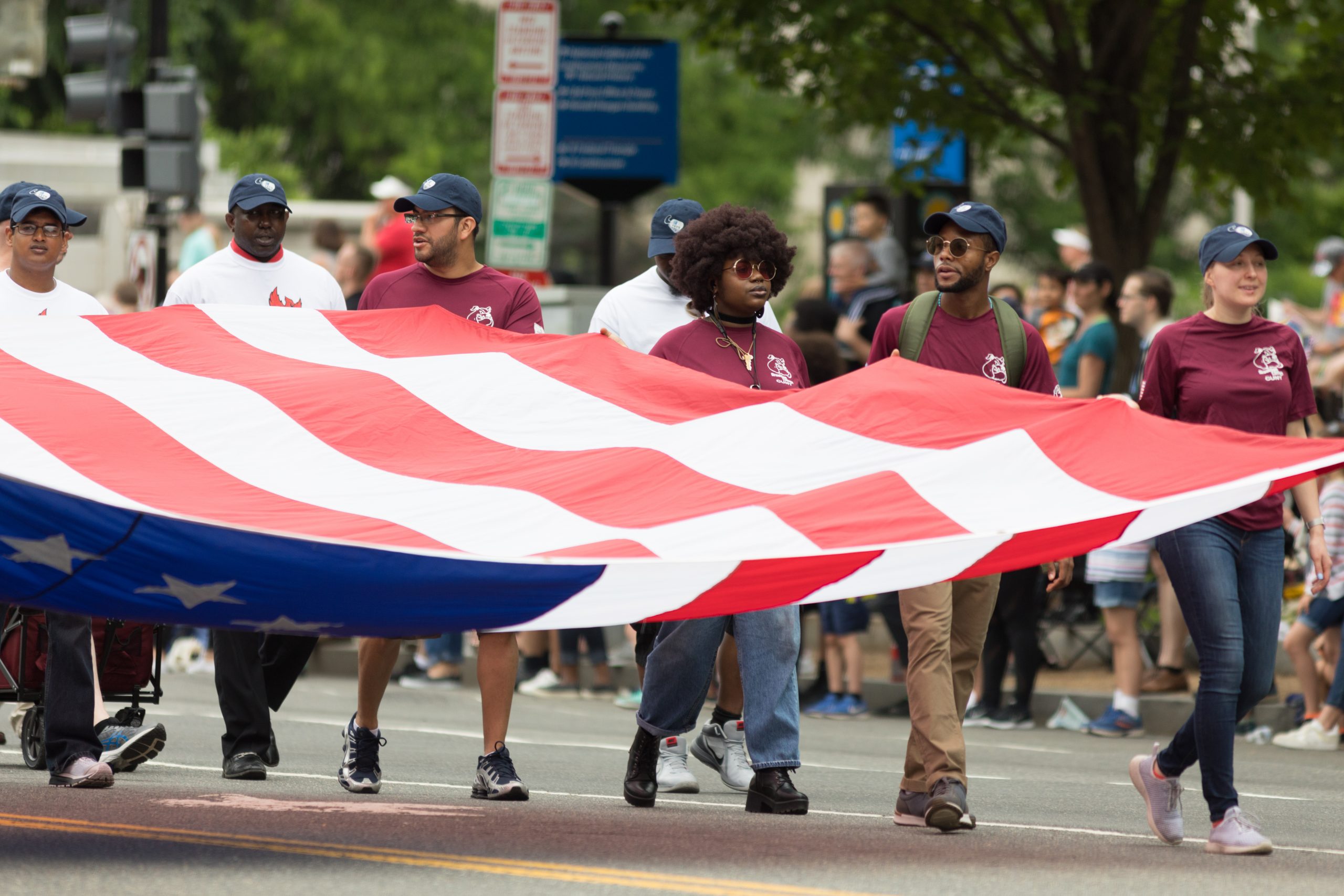
Cover Photo: Participants in a Memorial Day Parade in Washington, DC. Photo by Roberto Galen.

What We Learned Through NewsMatch Can Help All of Local News

/
May 14, 2019

There are almost-weekly reminders about the struggles facing local news. Last week the entire staff of the New Orleans Times-Picayune were laid off when the paper was sold to a competing paper. When 14 staff were laid off at the Cleveland Plain Dealer in April, it fell to one of those laid-off staff to cover the story. Zooming out, these individual stories fit into a troubling trend: America has lost nearly half its newspaper staff between 2008 and 2017, and almost 1,800 newspapers have closed their doors since 2004.

In the face of these struggles, the annual NewsMatch campaign, now entering its fourth year, provides a number of important lessons for how we can strengthen and support local news. NewsMatch is a national campaign that helped newsrooms around the country raise more than $7.6 million from hundreds of thousands of donors at the end of 2018. Today NewsMatch is releasing its annual learning report, which documents how the campaign meets three interlocking goals: Raising awareness about the role of journalism in our society, expanding community support and funding for news, and strengthening newsrooms’ long-term fundraising capacity.

We know raising awareness is a pressing need because the Pew Research Center recently found that 70 percent of U.S. adults think local journalism is doing well financially and only 14 percent have directly paid for local news. For local news in America to thrive newsrooms will have to dramatically shift public perception by engaging more deeply with audiences, documenting the impact of their journalism, and being transparent about the challenges they face. NewsMatch is creating new pathways both to raise awareness about the crisis in local news and enabling people to take action by supporting the quality journalism our nation needs.

Download the report at bit.ly/newsmatchlearning

Building Public Awareness About Nonprofit News

Between Nov. 1 and Dec. 31, 2018, the campaign helped 154 nonprofit news organizations across the country raise more than $7.6 million in unrestricted funding, which is being invested in more and better journalism, crucial general operating support, and improved fundraising capabilities. Since 2016, NewsMatch has helped nonprofit newsrooms raise more than $15.8 million for reporting and operations.

Core to the success of NewsMatch is how the program has helped spark a new kind of local and national conversation about the role of nonprofit news in America. The campaign runs a national awareness effort, provides 500+ hours of training to local and investigative newsrooms, creates a campaign-in-a-box toolkit for participants, and coordinates a national day of action called #GivingNewsDay in partnership with Giving Tuesday. These and other resources help newsrooms communicate their value and work to their community and ask for support, reminding people that good journalism shapes every other issue they care about.

The public is noticing. In two months — November and December of 2018 — over 240,000 people gave to news organizations. That is more than digital subscriptions to the Seattle Times, Boston Globe, Star-Tribune, and Dallas Morning News combined, according to a recent Wall Street Journal report. Critically, 52,000 of those donors were new and were supporting a nonprofit news organization for the first time. The year before, in 2017, 43,000 new donors gave for the first time during NewsMatch, for a two-year total of 95,000 new donors.

chart

The learning and evaluation report released today outlines how the team behind NewsMatch designed the 2018 campaign, what worked and what didn’t. It covers how NewsMatch operates, what we are learning about building community support for journalism and the impact the campaign is having on newsrooms, donors and philanthropy.

Helping Foundations See Local News as a Priority

In examining the lack of understanding of the local news crisis last month in Bloomberg, Gerry Smith wrote last month that many people “have yet to conceive of journalism as a critical component of a free society, and may not think of a newsroom in the same way they do the Salvation Army or the American Red Cross.” This disconnect persists even though a growing body of research has mapped our how the erosion of local news is tied to lower voter turnout, fewer candidates running for office, less responsive elected representatives, and an increase in corruption and government waste. It is not enough to expand individual donations, we must also create new on-ramps for local and national foundations to support nonprofit news. According to an analysis released last year by Northeastern University and Harvard’s Shorenstein Center local news comprised only 5% of total grants given to media from 2010 to 2015.

That is why NewsMatch is also creating new on-ramps for local and national foundations around the country to easily support and strengthen nonprofit journalism. NewsMatch has been designed as an open and trusted place for funders who want to invest in local news and investigative reporting and learn more about effectively supporting journalism. In 2018, NewsMatch continued to drive new philanthropic dollars to participating newsrooms:

  • The national matching fund grew to $3.7 million, an increase of 116 percent. Seven funders contributed to the national fund.
  • Regional and issue-focused funders offered partner matches for cohorts of newsrooms (for examples, newsrooms reporting on sciences and health, investigative newsrooms in the South, Colorado news outlets, etc.). Four funders set up these targeted matches alongside the main fund.
  • Participating newsrooms independently leveraged their participation in NewsMatch to secure more than $675,000 in additional, direct matches for their year-end campaigns. (This was down a bit from 2017.)
line

The campaign helps funders make the most out of their dollars by matching them with individual donations and supporting long-term capacity building in newsrooms. That capacity building work is starting to pay off. In a year when nonprofits overall only saw 1.5 percent year-over-year growth in individual donations, the average NewsMatch participant raised 11 percent more during the campaign in 2018 vs 2017. Small and medium newsrooms saw the biggest growth in year-end support, with 30+ percent increases in individual donors, donations, and dollars raised during NewsMatch. While the dollars raised during NewsMatch 2018 are notable, the real success is how the program is building long-term capacity for newsrooms to build meaningful connections with communities as readers and donors.

Growing the Campaign in 2019

Part fundraising program, part capacity building effort, and part public awareness campaign, NewsMatch achieves a complex set of goals while making it as easy as possible for anyone — individual donor, newsroom, funder — to participate. The Nieman Journalism Lab’s Christine Schmidt described how these elements come together, writing: “The campaign caught the budding nonprofit news sector at a critical stage in its growth and is giving it a jetstream by helping coach newsrooms, funders, and individual donors into seeding its future.”

NewsMatch participants at work: Hechinger Report, Texas Tribune, ProPublica, High Country News

NewsMatch was founded in 2016 by the John S. And James L. Knight Foundation and each year the number of NewsMatch participants has grown. That growth puts pressure on the national matching fund and we are currently seeking new and additional partners to support NewsMatch for 2019 and 2020. Support for NewsMatch 2018 was provided by the Colorado Media Project, Democracy Fund, Ethics and Excellence in Journalism Foundation, Facebook Journalism Project, John D. and Catherine T. MacArthur Foundation, Knight Foundation, Jonathan Logan Family Foundation, Present Progressive Fund at Schwab Charitable, Rita Allen Foundation, and Wyncote Foundation in partnership with The Miami Foundation, Institute for Nonprofit News and News Revenue Hub.

If we can together raise $5 million dollars for the national fund we can turn it into more than $10 million for local and investigative journalism this year. (If you are interested in exploring how to get involved in NewsMatch, or to set up a partner fund for a region or issue you care about, email Josh Stearns, jstearns@democracyfund.org.)

Based on what we learned from the 2018 campaign we are going to be making the materials and training more customized to serve the growing list of newsrooms who are at very different stages of growth and development. The NewsMatch team will also be working to better support organizations serving underrepresented communities and led by people of color. We recognize that it is critical for NewsMatch to do more to engage, listen, and serve these newsrooms, especially in light of longstanding inequities in how philanthropy has funded these organizations and communities. Finally, we will explore collaborations with others across the media landscape, beyond just nonprofit news, that can help drive more attention to the crisis in local news and the profound need to support it right now.

NewsMatch 2019 will kick off in November of 2019, but there is a lot of work to do before then. Find out more at NewsMatch.org and follow the campaign on Twitter and Facebook.


Democracy Fund Relaunches electionline

Stacey Scholl
/
October 18, 2018

Today we are pleased to unveil a new and improved electionline — America’s only politics-free source for election administration news and information.

In January 2018, we announced that electionline had become a project of Democracy Fund’s Elections program. We felt then, as we do now, that it is a vital platform for finding trusted news and information about the people and processes that guide our nation’s elections, and for sharing tools, best practices, and innovative ideas for improving the voting experience. Our simple goals for redeveloping the site were to enhance its capabilities and expand content — but our long-term plans are to create a place where readers are exposed to new ideas, opportunities for continuing education, and relationship building.

To do this, we started by thinking long and hard about the site’s current audience and their needs. Starting today, election administrators, academics, voting advocates and other regular readers of electionline will find new items of interest on the site, including:

  • A calendar of national, state and other field-relevant events;
  • A directory of organizations and their areas of expertise;
  • Reports, trainings, tools, guides, and other materials;
  • A marketplace featuring job openings in the elections field and information on used election equipment for sale; and
  • Better search functionality throughout

Electionline remains the only place on the internet to find state-by-state curation of daily election administration news. In addition to publishing the classic electionline Weekly newsletter, we will also begin sharing original reports and exclusive content from leaders and experts in the field — making the site a must-read for local election officials, civic organizations, and journalists who cover elections.

While redeveloping the site, we learned two really insightful lessons that might be helpful for others who are developing virtual spaces for information sharing and engagement.

First, collaborate with your audiences and include some “outsider” perspective. As our team weighed important decisions about the look and feel of the website, we were grateful to receive insight and direction from many readers who already trust and rely on electionline.

Second, reflect your values. Redeveloping or creating a new platform is an opportunity to reinforce essential characteristics that inform readers who your organization is, and what they care about. For us it meant focusing on authenticity (even if it means publishing unflattering stories about ourselves or our partners); transparency about who we support with resources in the field; and cultivating greater interest for under-covered areas of importance like voting trends for overlooked communities.

Through this process, we hope we were able to successfully incorporate the feedback we heard from current readers. We also hope that the new electionline website more deeply resonates with all those who are interested in elections in America. We’re excited to hear your thoughts and reactions as you explore the new website. Please visit www.electionline.org and let us know what you think!

Democracy Fund Welcomes New Teammates

February 26, 2018

​Diverse perspectives inform us, passion for impact fuels us, and the power of action together ignites us. As chief people officer of the Democracy Fund, I am inspired by the individuals with whom I work side by side — and even more excited by the alchemy generated by each of our teams.

​We have grown more than 40 percent from just a year ago — and we’re still seeking a few more essential team members. Since last summer, each department has augmented its team carefully — whether deepening our ability to execute on established strategies, adding capacity for new initiatives and projects, or bringing needed expertise in-house. We believe that inclusion of voices of people across multiple and diverse political, racial, ethnic, gender, and other identities is necessary to find achievable solutions to the complex problems facing our democracy. Terrific additions to our passionate and dedicated staff are creating new forces for impact on every team. I’ll start, however, with one important role expansion before discussing build out of our teams.

​Strategy and Program

​Srik Gopal, Vice President of Strategy and Program: Srik, who joined Democracy Fund in 2016, has played a key role in the development of our Strategy, Impact and Learning team. We are thrilled to announce the expansion of his role to Vice President of Strategy and Program, where he will focus on guiding the organization’s overall programmatic portfolio. “As he moves into this new position and begins working more closely with program, Srik remains dedicated to supporting a culture of learning within the organization, and ensuring that our work remains impactful in the field,” said Joe Goldman, President of Democracy Fund.

​Liz Ruedy, Director of Evaluation and Learning: Liz joined the Strategy, Impact, and Learning team from the International Republican Institute — bringing extensive experience in evaluation, a broad-based knowledge of democracy, and fluency in systems thinking and inquiry-based approaches. Liz oversees our ongoing efforts to design and implement evaluations that capture our organization’s impact and provide greater insight into our political and civic systems. “Liz will be instrumental in helping achieve our quest to be a truly adaptive learning organization,” said Srik Gopal, Vice President of Strategy and Program.

​The Governance Team

​Lara Flint, Associate Director for Oversight and Congressional Capacity: As our first Associate Director for Oversight and Congressional Capacity, Lara focuses on checks and balances and the rule of law to strengthen safeguards that ensure our government is transparent and accountable to the public. Most recently chief counsel for national security to then-Chairman Patrick Leahy of the Senate Judiciary Committee, Lara brings over 15 years of experience in long-term congressional oversight and the ability to develop and maintain bipartisan coalitions across government, civil society, industry, and other stakeholders. “Lara’s extensive policy expertise, legal know-how, Capitol Hill experience and can-do approach have already brought even more energy, knowledge, strength and depth to our strategy development and grantmaking, and to Democracy Fund as a whole,” said Betsy Wright Hawkings, Program Director of the Governance team.

Nathaniel Turner, Program Associate for Oversight and Congressional Capacity: Nathaniel joins the team as a new Program Associate for Oversight and Congressional capacity. Nathaniel most recently served as a legislative assistant at the American Civil Liberties Union, where he advocated before Congress on issues of surveillance reform and cybersecurity. “With his passion for protecting the rule of law, his valuable nonprofit experience, and his strong organizational skills, Nathaniel has jumped right in – and is already a tremendous asset to our work to strengthen government accountability and transparency, ” said Lara Flint, Associate Director for Oversight and Congressional Capacity.

Sean Raymond, Program Associate for Oversight and Congressional Capacity: Sean, who first joined Democracy Fund as an intern and then played a key role as program assistant, has assisted in building out both the team’s oversight and capacity work, bringing on-the-ground experience in campaigns and on Capitol Hill. “His recent promotion to Program Associate serves as recognition of the superior work he has done for the team, and we are so fortunate to have him supporting the capacity work full time,” said Betsy Wright Hawkings. Sean graduated magna cum laude from George Washington University with a BA in political communication, and American history.

Anne Gleich, Program Assistant: First joining the Democracy Fund as an intern during the summer of 2017, Anne has since integrated seamlessly into the Governance team, and organization as a whole. Anne joins us from Hastings, Minnesota, and is a recent graduate of the College of Saint Benedict, where she received a B.A. in Political Science. “We count on her to take the lead on innovating projects, knowing we can throw any ball at her and she will catch it and run. Anne is the capstone on a great team, and we are truly grateful to have her join us permanently as a Program Assistant,” said Betsy Wright Hawkings.

​The Public Square Team

Nadia Firozvi, Project Manager for the Special Project on Fostering a Just and Inclusive Society: Nadia joins us from the Department of Homeland Security, where she was a Policy Advisor in the Office for Civil Rights and Civil Liberties. She also has served as Domestic Policy Coordinator at the Arab American Institute, and as a Staff Attorney at the Asian Pacific American Legal Resource Center. “We’re very fortunate to have Nadia directing the Just and Inclusive Society initiative. With her previous background at the U.S. Department of Homeland Security, along with her extensive expertise in civil rights law, Nadia brings significant insight to our team, and will be instrumental to the success of our project,” said Tom Glaisyer, Managing Director of the Public Square team.

​Lea Trusty, Program Assistant: As a Program Assistant for the Public Square team, Lea will support our work on Engaged Journalism. Prior to joining Democracy Fund, Lea served as a Newman’s Own Foundation Fellow, where she was placed as a journalist at WSHU Public Radio-an NPR affiliate in Connecticut. Lea graduated magna cum laude from Princeton University, where she studied politics and Latin America. “Lea brings dedication, enthusiasm, and intellect to her role on the Public Square team. She has already found new opportunities to support our growing network of journalists, grantees, and peer funders, and we are excited to see Lea develop as she explores increased support for women in journalism as a teachable method for audience engagement,” said Paul Waters, Senior Associate on the Public Square team.

​The Elections Team

Trevor Ostbye, Program Associate: Trevor most recently served as National Coordinator at the Lawyers’ Committee for Civil Rights Under Law, where he worked on Election Protection, the nation’s largest nonpartisan voter protection coalition. Trevor previously coordinated the creation of a bipartisan coalition around innovative strategies for workforce development at Hope Street Group and has a JD from Wake Forest University. “Adding Trevor to the Elections team has meant improving how we do our work, not just increasing what we can do. He brings keen insight, on-the-ground experience from his time in the voting rights community, and a willingness to dive into the complex ideas and needs of our field. He’s an impressive listener, which makes him a great thought partner. Team members, like myself, are so glad he’s at Democracy Fund,” said Stacey Scholl, Senior Associate on the Elections Team.

​Communications and Network Team

Our Communications and Network Team requires the ability to work collaboratively, flexibly, and creatively with internal and external partners and has added two key people who embody those capabilities.​

Nick Fabiani, Design Associate: Nick is responsible for elevating the Democracy Fund brand and brings digital communications experience from both the philanthropic world as well as political campaigns. He was digital communications manager for Grantmakers for Effective Organizations and served as the digital marketing manager for the Democratic Senatorial Campaign Committee and other campaigns. “Nick was the Digital Communications Manager at GEO, where he led the brand redevelopment of their website and brand. He brings to Democracy Fund a keen visual eye paired with a rich understanding of the philanthropic world, both of which promise to elevate the work of our grantees, partners, and programs,” said Lauren Strayer, Managing Director of Communications and Network.

​Courtney Hytower, Communications Assistant: As Communications Assistant, Courtney expands the Democracy Fund’s reach and influence, and fosters collaboration among its grantees and with other major leaders in the field. Courtney first joined the Democracy Fund in October 2016 as an intern, following the completion of her undergraduate degree at Syracuse University where she graduated magna cum laude with a B.A. in Political Science and a B.A. in Writing & Rhetoric. “Courtney plays an essential role on the Communications and Network Team as a project coordinator and as a thought partner. She has a passion for messaging and best practices that adds to our team’s impact,” said Lauren Strayer.

​Operations and People Team

​On the Operations and People side, the passion and dedication to job excellence and being a team player are exhibited by all of our recent hires.

​Adele Cameron, Operations Assistant: Adele ensures a smooth-functioning office environment and supports Operations. With a degree in political science and international relations from Houghton College, Adele is passionate about learning and our work. “Adele brings over 12 years of extensive administrative experience and passion for people and for making processes better. Her commitment to managing our resources well, and creating a space where people can bring their best selves to the office, makes such a difference in our culture every single day,” said Hugo Castro, Operations Manager.

Sharlene Patel, Accounting and Grants Assistant: Sharlene manages the payables function and the general ledger’s day-to-day activities to ensure accuracy in all our reporting. Additionally, she helps maintain the grants database from a reporting standpoint. Sharlene previously worked extensively in the private and public accounting sectors, and has worked with several non-profits in the DMV area. She holds a Bachelor’s degree in Accounting, with a minor in Finance from St. John’s University. “Sharlene has been a great addition to the Operations team,” said Robin Thompson, Controller, “where her experience managing day-to-day finance activities with a focus on client service is exactly what we needed to round out the Finance function in support of the various teams at Democracy Fund.”

​Lise Woods Fink, Senior Recruiter: Finding fabulous people, as enumerated above, is a special talent. Democracy Fund’s Senior Recruiter, Lise Woods Fink, brings fierce passion for community building along with over 20 years of experience in recruitment, human resource, and other capabilities to Democracy Fund. Prior to recruiting for Democracy Fund throughout 2017, Lise was instrumental in creating and launching First Look Media, where she oversaw talent and community curation, and growing the Omidyar Network, where she focused on executive search, talent management, and organizational design and development. Earlier, she spent six years at Apple as an executive recruiter and as a product development manager, where she spearheaded company-wide human capital initiatives. “As her manager, I count my blessings daily, not only for the talent she has helped to bring through our doors, but also her wisdom, passion for people, and positive energy that have continued to enrich our organizational culture,” said Margaret Yao, Chief People Officer.

​Democracy Fund continues to seek a diversity of expertise, perspective and lived experience to build out our teams — because each member of Democracy Fund’s staff makes a difference as an individual and as part of a collective whole. To learn more about our organization and to see our available positions, visit https://democracyfund.org/page/jobs.
Welcoming New Teammates to the Democracy Fund

Democracy Fund
/
April 11, 2017

The Democracy Fund team is a group of remarkably passionate and dedicated people from all walks of life and across the political spectrum. As we face new challenges and embrace new opportunities, we are proud to welcome three outstanding additions to our team. Spanning a wide range of experience and interests, we are confident that these individuals will bring the skills and diverse perspectives that are critical to our work to help strengthen democracy.

On the program side, please join us in welcoming Laura A. Maristany, the Democracy Fund’s new Associate Director for Constructive Politics in the Governance Program. A seasoned advocate with extensive Capitol Hill and legislative experience, Laura previously served as chief federal advocate and Director of the Washington, D.C. office for the National Association of Latino Elected and Appointed Officials (NALEO). Laura also served as Executive Director of Legislative Affairs for the Hispanic Association of Colleges and Universities (HACU). At both organizations, Laura played a key role in developing and implementing their respective legislative agendas and developing relations with Congress, the Administration, federal agencies, and other national organizations. At the Democracy Fund, Laura will lead the Governance Program’s efforts to strengthen the congressional political system by fostering more constructive political engagement and a healthy two-party system.

“We so grateful to have Laura join our team,” said Betsy Wright Hawkings, Director of the Democracy Fund’s Governance Program. “With her strong organizational skills, experience developing relationships with leaders on both sides of the congressional aisle and across the federal government, and proven ability to partner with other national organizations, Laura will be a tremendous asset in helping the Democracy Fund promote the ability of elected officials to cooperate and find common ground.”

Our Operations team has been growing as well. Bringing an extensive background in financial management, auditing, compliance, and operations management for nonprofit organizations, we are delighted to welcome our new Controller, Robin Thompson, to the team. Robin will plan and oversee the Democracy Fund’s financial resources, including implementing and managing new, more efficient systems for our complex and growing organization.

We are also happy to welcome Lorna Kerr, our new Human Resources Associate. Focusing specifically on diversity and inclusion, performance management, learning and development, and a host of other human resource functions, Lorna will help us cultivate a values-driven culture at the Democracy Fund that brings out the best in our rapidly growing, diverse staff.

“Robin and Lorna both bring deep experience in their respective fields and a passion for motivating people and implementing best practices,” said Tony Bowen, Director of Grants Management and Operations. “We are very excited to have them join our growing organization and help us professionalize our internal operations so we can better serve our partners and support our teams as we work to make democracy better.”

To learn more about our staff, please visit www.democracyfund.org/about-us. We will keep you updated as we continue recruit for several open positions at the Democracy Fund.

My 9 Resolutions for 2017

/
January 18, 2017

Before we get too much farther into January, I want to take a moment to wish everyone a Happy New Year on behalf of the Democracy Fund team.

I’ve always believed that developing resolutions for the new year is a powerful act of renewal and commitment. 2017 brings with it a wide range of challenges to our democracy that are deeply concerning. But it is also an opportunity for each of us to apply what we’ve learned from the past to our future plans and to recommit ourselves to those principles that we each hold most dear.

I hope you will consider joining me in making the following resolutions:

  1. I will remember that while our democracy is resilient, it is more deeply vulnerable than many of us realized and requires constant vigilance.
  2. I will seek to engage and understand people who anger me, rather than shaming and isolating them.
  3. I will do my best to keep in mind that history is long and conditions change in unexpected ways (both for the good and bad).
  4. I will remember that I have blind spots and that perceptions based on recent history may be wrong (especially in our new environment).
  5. I will speak out when I see injustice and stand up for those who are targeted by bullies.
  6. I will look to support efforts that are ambitious enough to make a difference, even if there is significant risk they may not succeed.
  7. I will be unafraid to fail and will make every effort to learn from experiments that don’t work out.
  8. I will remain committed to strengthening the core institutions and norms of our democracy.
  9. I will maintain my confidence in the goodness and wisdom of the American people (even when it can be challenging to do so).

In times of uncertainty, the value of a strong community of diverse voices is clear. Discussing our values and concerns with trusted peers and reaching out beyond our immediate networks to hear new perspectives will help make our work to promote healthy democracy more effective.

At the Democracy Fund, our staff includes Republicans, Democrats, and Independents who are committed to working together to make our democracy work better. In 2016, we hired 10 new full time members of our staff – and as we look ahead to 2017, we are continuing to recruit for several open positions.

Today, I’m pleased to welcome five new leaders to our National Advisory Committee:

Anthea Watson Strong, a lead on the Civics team at Google, builds products that help decision makers govern more effectively, help people access public services more efficiently, and help users engage in the civic process.

Charles J. Sykes is one of the most influential conservatives in Wisconsin. The author of eight books, he is a senior fellow at the Wisconsin Policy Research Institute, founder and editor in chief of the website Right Wisconsin, and is the editor of Wisconsin Interest magazine.

Geneva Overholser is an independent journalist and media critic in New York City. She is a former ombudsman for the Washington Post and editorial board member of the New York Times. Previously, she was editor of the Des Moines Register, where she led the paper to a Pulitzer Prize for Public Service.

Kristen Soltis Anderson is a researcher, pollster, and political analyst. She is a leading expert on the millennial generation and is author of The Selfie Vote: Where Millennials Are Leading America (And How Republicans Can Keep Up). In 2013, she was named one of TIME Magazine’s “Thirty Under 30 Changing The World.”

Sonal Shah is a global leader on social innovation policy, including impact investing, data and technology for social good, and civic engagement through government, business, philanthropy, and civil society. Previously, she founded the White House Office of Social Innovation and Civic Participation where she led the Obama Administration’s efforts to leverage technology and partnerships to solve some of the nation’s toughest challenges.

Please visit our About Us page to learn more about our team. Together, we are committed to finding achievable solutions to our nation’s biggest problems and will work to ensure that our political system is able to withstand new challenges and deliver on its promise to the American people in 2017 and beyond.

Welcoming New Democracy Fund Teammates

Democracy Fund
/
December 20, 2016

Democracy Fund has grown a lot in 2016. Since January, we have hired 10 new full time members of our staff – and as we look ahead to 2017, we are continuing to recruit for several open positions.

As an organization, we believe that the inclusion and participation of diverse voices from across the political spectrum and from all walks of life is critical to our work to strengthen our democracy. Our staff includes talented, tireless Republicans, Democrats, and Independents who are committed to working together to make our democracy work better.

We are delighted to welcome our new Board Member, Sarah Steven, our three new Senior Fellows, Daniela Gerson, Marty Kaiser, and Rick Shapiro, and three new staff members, Isaiah Castilla, Teresa Gorman, and Robin Stevenson.

  • Sarah Steven is the newest member of Democracy Fund’s board of directors. Since 2008, Sarah has held a variety of communications and program management roles across the organizations and initiatives of The Omidyar Group (TOG), where she currently serves as Director of Communications. Sarah works closely with Pierre and Pam Omidyar, their advisors, and leadership teams, to develop communications strategies and platforms that allow TOG to share its efforts, key findings, and unique contributions with targeted audiences. With a career spanning more than two decades, Sarah draws from a diverse set of professional experiences beginning in Washington, D.C., where she managed public affairs programming for such clients as Home Box Office, Microsoft, and the Centers for Disease Control and Prevention. In Silicon Valley, she worked with both Fortune 500 companies and startups on programs ranging from environmental sustainability to consumer and enterprise technologies and services. Sarah holds a B.A. in communications from George Mason University.
  • Daniela Gerson is a Senior Fellow for the Public Square Program. Bringing extensive expertise in immigration reporting and participatory media, Daniela will advise on ways to strengthen ecosystem news through journalism innovation and engagement with multiethnic communities. In fall 2016 Daniela joined the California State University Northridge Journalism Department as its first assistant professor with a focus on community, ethnic, and participatory media. Previously, Daniela worked with the Los Angeles Times as a community engagement editor, charged with bringing in new perspectives that reflect the diversity of L.A. and with creating feedback loops to inform coverage. Before joining the Los Angeles Times, Daniela directed the Civic Engagement and Journalism Initiative at University of Southern California’s Annenberg School for Communication and Journalism. She has also reported for Financial Times Magazine, The New York Times, PRI’s The World, Weekend America, Der Spiegel, WNYC: New York Public Radio, among other outlets.
  • Marty Kaiser is a Senior Fellow for the Public Square Program. He is a nationally recognized media consultant specializing in leadership, digital innovation, ethics, investigative reporting, and editing. He has worked in the United States, Canada and Europe. He was Editor/Sr. Vice President of the Milwaukee Journal Sentinel from 1997 to 2015. Under his leadership, the Journal Sentinel earned a national reputation for its journalism and digital innovation. Kaiser’s newsroom won Pulitzer Prizes in 2008, 2010, and 2011 and was honored as a finalist six other times from 2003 through 2014. While he was editor, the Journal Sentinel won awards in almost every major U.S. journalism contest. Columbia Journalism Review wrote that the Journal Sentinel had one of the most acclaimed watchdog teams in the country, period.
  • Rick Shapiro is a Senior Fellow for the Governance Program. He is the President of Strategic Assets Consulting, a management consulting firm that specializes in providing services to federal, state and local government, non-profit organizations, and businesses. Previously, Rick served as Executive Director for the Congressional Management Foundation (CMF), a non-partisan, non-profit organization dedicated to improving the effectiveness of Congress. Over the past 25 years, Rick has provided management consulting services to leaders in both the House and Senate and more than 200 House and Senate offices. He has authored or co-authored of a number of books and reports on congressional operations, and testified before Congress. He has appeared on the CBS Evening News, CNN, C-Span, CNBC, and National Public Radio and is frequently cited in newspaper, radio, and television stories about the Congress. Rick holds a Bachelor’s degree in Communications from the University of Illinois and an MPA from the Woodrow Wilson School at Princeton University.
  • Isaiah Castilla joins the Democracy Fund as Senior Counsel, bringing an array of knowledge to our team as he both oversees the Democracy Fund’s legal affairs and provides guidance on its strategy development. Isaiah previously served as the Bolder Advocacy Counsel at Alliance for Justice (AFJ) where he advised foundations on how best to maximize their advocacy capacity. Before joining AFJ, Isaiah was the founding partner of The Castilla Law Group, where he simultaneously managed a caseload of civil and criminal matters and provided legal guidance to nonprofits and political organizations. Isaiah holds a J.D. from Mississippi College School of Law, and earned a BA in Music from Tougaloo College where he graduated magna cum laude.
  • Teresa Gorman joins the Democracy Fund as the Local News Associate for the Public Square Program, supporting the Public Square team’s mission to invest in innovations and institutions that help people understand and participate in the democratic process. Teresa previously worked as the Supervising Producer of “Localore: Finding America,” for the Association of Independents in Radio, adapting new storytelling models to meet the individual needs of communities across the country. She has spent her career at the intersection of public media, local news, and digital media, working as one of the first ever social media editors for PBS NewsHour. Teresa attended Boston University where she received her BS in Journalism.
  • Robin Stevenson joins the Democracy Fund as the Executive Assistant to the President and Vice President of the Strategy, Impact, and Learning, bringing more than 25 years of related professional experience to the position. She recently she served as the Assistant to the Regional Chief Operating Officer of MGM Resorts International. Robin previously has worked as the Executive Assistant for various Vice Presidents and Directors at The American Institute of Architects, the Pope John Paul II Cultural Center, and George Washington University Hospital.

To learn more about our board, fellows, and staff, please visit www.democracyfund.org/who-we-are.

Progress Report Shows Promising Gains for Voting Access & Efficiency

Stacey Scholl
/
October 20, 2016

In 2014, the Presidential Commission on Election Administration (PCEA) highlighted best practices in election administration to improve the voting experience for all Americans. The bipartisan group, lead by chief attorneys for President Obama and Governor Romney’s campaigns, released a comprehensive—and unanimous—set of recommendations to make voting easier and more efficient.

In advance of the 2016 presidential election, we wanted to know: what recommendations were adopted and where? Answers to these questions became the Democracy Fund Progress Report on the PCEA. In it dozens of election officials and stakeholders reveal areas of improvement, notably:

  • Modernizing voter registration systems;
  • Expanding early voting and access to voting;
  • Reducing lines and improving polling place management; and
  • Modernizing voting technology.

Modernizing Voter Registration

A major recommendation was expanding Online Voter Registration (OVR), which is valued for its usefulness to both voters and election administrators. Since the release of the Commission’s report, the number of states with OVR has doubled to 39, including the District of Columbia.

Other recommendations continue to impact voter registration in major ways. Due in part to the Commission, two networks that facilitate voter registration information sharing between states, for the purpose of improving the accuracy of voter rolls, have grown. Voter Registration Crosscheck now has at least 29 states participating and 20 states and the District of Columbia have joined the Electronic Registration Information Center.

Expanding Early Voting and Access to Voting

The PCEA report also spurred five states to adopt forms of early voting or expand its role in comprehensive election plans. There is a drastic change in Massachusetts, where prior to 2016, most voters had one alternative to voting on Election Day: have a legally accepted excuse and vote an in-person absentee ballot. Under the new law, there will be 11 days of in-person early voting at multiple sites across the Commonwealth.

There has been a reinforcement of ideas to help military and overseas voters. A working group formed by the DoD’s Federal Voting Assistance Program and the Council of State Governments built on the PCEA’s recommendations. Notably, they recommended that military and overseas voters should be sent absentee ballots for all elections during a two-year period and asked states with OVR to designate a section of their portals for these unique voters.

Reducing Lines and Improving Polling Place Management

Polling places are changing for the better with data-informed innovation. In 2015, the Voting Technology Project published an online Elections Management Toolkit to help officials allocate polling place resources, allowing them to model line lengths based on past data. Videos even walk election officials through using the tools.

States are also taking action to recruit public and private sector employees and students, to become poll workers. Rhode Island and Illinois started programs to recruit student workers as a catalyst for increased voter participation among young people. Additionally, the Bipartisan Policy Center and Democracy Works successfully recruited Spotify, Starbucks, Target, and several other large companies in a coordinated effort to generate greater civic participation among their employees.

Modernizing Voting Technology

With strong urging from the PCEA, the U.S. Election Assistance Commission approved new voting system certification guidelines and a manual for certification and testing. The hope is these actions encourage voting machine vendors to bring new systems to market.

The accounts of PCEA influence are revealing that our system is open to change. In fact, the bipartisan efforts to implement the recommendations of the Commission are a sign of possibilities when people work together. We acknowledge that problems will occur this November; any time 100 million plus people do anything, problems will occur. For those places where problems emerge, there are some solutions to be found in the guidance of the PCEA or the bipartisan spirit of their work. We are encouraged by this progress and look forward to continuing to work with our grantees, election officials, and advocates to improve the voting process for all Americans.

Democracy Fund
1200 17th Street NW Suite 300,
Washington, DC 20036