Statement
May 6, 2026

For more than fifty years, the Southern Poverty Law Center has endeavored to protect those most vulnerable to hate, safeguard communities, and advance the principle that every person in this country deserves dignity and equal treatment.

We are living through a broader moment that demands we name what we are seeing. The organizations and institutions that protect our democracy are under sustained and coordinated pressure. There is a documented pattern of the federal government threatening nonprofit organizations, law firms, and even public servants who disagree with the current administration, a pattern that courts have rebuked repeatedly.

And as with law firms and universities, financial institutions and other intermediaries critical to charitable work now appear to be acting out of intimidation. When donor-advised fund sponsors preemptively decline to process contributions to civil rights organizations, the effect is no different from any other form of targeted pressure. It chills free speech and erodes our democracy.

As funders committed to democracy, justice, and the long-term health of civil society, we boldly stand with the Southern Poverty Law Center and with the broader civil rights community. We will continue to resource organizations defending rights and freedoms. And we will continue to call out the difference between legitimate accountability and the use of government power to silence critics.

Our democracy depends on a vibrant civil society and the freedom to organize, advocate, litigate, and express alternative points of view. We will not back down from the defense of our most vital freedoms.

This moment calls for a united voice. We hope you will join us.

SIGNERS

Aaron Dorfman, National Committee for Responsive Philanthropy
Adasina Social Capital
Adelaide Park Gomer, President – Park Foundation
Akonadi Foundation
AL Advising
Allison Budschalow
Alissa Keny-Guyer
Andrew Goodman Foundation
Anonymous
Anonymous
Anonymous
Arch Community Fund
Asian Americans/Pacific Islanders in Philanthropy
A. Sparks
Bernard and Anne Spitzer Charitable Trust
Betsy Fairbanks
Brighton Jones
Butler Family Fund
Carol Cruickshank
Catherine Raphael
Chicory Wealth
Clara Miller
Common Counsel Foundation
Communitas Financial Planning PBC
Community Foundation of Mendocino County
Conant Family Foundation
David Baron
David Bronner
Democracy Fund
Don Chen, Surdna Foundation
Dorothy Quincy Thomas
Dr. John W. Cavanaugh, Ph.D.
Eddy Morales, Philanthropic Advisor, Morales Public Relations
Edie Harding
Ellen Evans
Emily Teitsworth
Erin Yanke
Foundation for Middle East Peace
Franklin Weinberg Fund
Fred Blackwell
Freedom Together Foundation
Geraldine R. Dodge Foundation, President and CEO
Grantmakers for Effective Organizations
Grantmakers in the Arts
Greg Taylor
Humanity United
Humanize Wealth
Hyams Foundation
Isabelle Murphy
Jackie Nirenberg
Jeff Meer
Jera Oliver, JD, MPA
John H. Jackson
Jon Fine
Jubitz Family Foundation
Karina O’Malley
Kataly Foundation
Kenneth Rainin Foundation
Kristin Anderson
Laughing Gull Foundation
Laurie Schecter
Leslie Ramyk
Lucas Garrett
Marc Bendick Jr and Mary Lou Egan Charitable Trust
Margaret Dooley-Sammuli
McGregor Fund
Michelle Puckett
Miguel A. Santana
Movement Strategy Center
Mx. Chris Talbot
Nat Chioke Williams
Northwest Area Foundation
Onion Foundation
Open Society Foundations
Parker J. Palmer
Peter A. Facione
Philanthropy Northwest
Philip W. Eubanks
Phyllis B. Rubin
Pia Infante
Pink House Foundation
Principled Investing, LLC
Priscilla Kersten
Propel
Racial Justice Investing Coalition
Radical Imagination Family Foundation
Raikes Foundation
Ray Colmenar
Richard and Lynn Voelbel
Rickke Mananzala
Robert Wood Johnson Foundation
Roger + Margot Milliken
Ruth Goldman
Samantha Anderson
San Francisco Foundation
Scherman Foundation
Sophie Allen-Etchart
SSoqo, Unitarian Universalist Service Committee
Stonewall Community Foundation
Susan Lowenthal Axelrod
Susan Orkin
Susan Thomas
Tara Health Foundation
The Albert Pick, Jr. Fund
The Arca Foundation
The California Endowment
The Grove Foundation
The Puffin Foundation
Theresa Ellis, Liminality Partners
Tides
Timothy Silard
Tina Barber
Todd Quackenbush
Tom Mendelsohn & Julia Gittleman
Unbound Philanthropy
United Philanthropy Forum
V. Frothingham
Voices for Progress
Wallace Global Fund
Washington Women’s Foundation
Way to Rise
Way to Win
Weissberg Foundation
Woka Foundation
Women’s Foundation of Minnesota
Xavier Ramey, Justice Informed

Statement
April 29, 2026

The Supreme Court ruling on the Voting Rights Act (VRA) marks a defining and deeply disappointing moment for American democracy. The VRA ended Jim Crow. Since that moment, the VRA has been one of our nation’s most effective safeguards for equal access to the ballot — especially for Black and brown communities who have long faced systemic exclusion from full participation in civic life.

That protection has now been ripped away. And the consequences will be felt in communities, and limit our ability to have free and fair elections.

Today, philanthropy faces a clear choice: to either meet this moment with urgency and boldness or allow the decay of our democratic freedoms. Free and fair elections depend on strong infrastructure, trusted community organizations, and sustained investment particularly in the South, where the legacy and reality of voter disenfranchisement remain most acute.

Over the past three years, Democracy Fund has invested over $20 million into community-based organizations serving Black and brown communities to strengthen our multiracial democracy and ensure equal access to the ballot box. These investments have supported voting rights litigation, community organizing to expand the freedom to vote, and nonpartisan voter education. But our investment isn’t enough. We call on every foundation and donor across the country to act now. An investment in these organizing groups will ensure that those most affected by this decision have the resources to respond now and build for the long-term.

What happens next in our country will depend, in part, on whether philanthropy is willing to meet the scale of this challenge.

This is not a moment for business-as-usual philanthropy. It is a moment to align our analysis and our action.

External Content
March 18, 2026

Democracy donors note that advocates, organizers and litigators report feeling stretched thin right now and that the demands of raising core operating funds persist while new areas of work continue to emerge that require additional resources. Late gifting has long been problematic. Since 2024, the All by April campaign has worked to move monies earlier to those engaged in voter education and engagement, voting rights issues and election security concerns.

External Content
December 11, 2025

Never mind April, how’s December? For the second election cycle in a row, the Democracy Fund is urging donors to step up early to sustain nonprofits doing the heavy lifting of democracy protection, preservation and defence well in advance of upcoming votes. In 2024, the Democracy Fund launched All by April, a nonpartisan campaign focused on ensuring free, fair and representative elections (see IP’s coverage here). Now, it’s re-upping the campaign leading into what is shaping up to be a hotly contested and chaos-filled midterm election year.

Blog
/
December 16, 2024

I want to end the year on a note of gratitude and pride for the many ways our community came together to defend and advance a democracy that is open, just, resilient, and trustworthy for all Americans. While I am clear-eyed about the threats facing us and the hard work ahead, I remain determined to stand up for our democracy in these challenging times.

This year, Democracy Fund celebrated its tenth anniversary as an independent grantmaking foundation. Along with our partner organization, Democracy Fund Voice, we have made more than $425 million in grants to promote free elections, a just society, an equitable public square, and accountable government institutions. I would be remiss to end the year without expressing my deep gratitude to all the grantees, partners, and staff that have helped to build this remarkable institution and community of fierce democracy advocates.

This decade has profoundly shaped our democracy, our organization, and my growth as a leader. My understanding of philanthropy’s role in empowering change has evolved along the way. In the face of rising threats to our democracy, I am sharing five lessons I’ve learned, hoping they’ll be valuable to others in the field.

1. Funders can’t shy away from tough conversations — or bold action — in defense of our values.

Many in the philanthropic field are worried about the rising critiques against progressive philanthropy and the emerging threats against the causes and communities many of us hold dear — from immigration, to the LGBTQ+ community, racial justice, and so many more.

Democracy Fund and Democracy Fund Voice stand strong in our commitment to an inclusive, multiracial democracy. We will not back down. Our work is part of a long tradition of fighting for a democracy that truly represents and serves all Americans — a democracy that we have never yet achieved.

It took a lot of learning on our part to get to where we are today. Ten years ago, Democracy Fund and Democracy Fund Voice started with a bipartisan approach, and an incremental and reformist mindset. We thought that broader political buy-in to reforms would be key to improving resilience over time. But that’s not what happened.

We soon realized that we would need to fundamentally revisit our thinking if we wanted to continue to live within our values. We wrestled through a series of tough conversations that resulted in us “declaring independence” from bipartisanship and creating a new organizational framework in 2021. The process of articulating a more explicit set of core values and a bolder perspective on the fundamental inequities of our democracy transformed our strategy, our staff, our organizational culture, and our position in the field.

I am proud we did not shy away from asking ourselves difficult questions about who we were and what it would take to pursue impact as the world changed around us. Doing this work provided us with a clear rallying point around which to stand boldly in defense of our values and our grantees.

As our sector faces new and emerging challenges today, we have revisited this experience and are in the process of articulating a set of principles to guide our posture moving forward. I encourage our philanthropic peers to face this moment with deep introspection and determination – and a willingness to let go of the familiar where necessary to make transformative change.

2. How we fund matters — and it’s up to us to give better.

Our grantees’ feedback has consistently been a source of essential learning – and it has not always been easy to hear. I still remember a 2014 grantee assessment that compared Democracy Fund’s grants diligence process to a particularly uncomfortable doctor’s visit.

Listening to our grantees and learning from our partners, we have increasingly shifted our grants application and reporting processes to be less onerous for grantees. We have significantly increased the proportion of our grants that are larger, multiyear, and unrestricted. By implementing new processes such as verbal reporting, we’ve shifted much of the diligence and reporting burden onto our own shoulders. We’ve become better and more supportive grantmakers, and are gratified in these efforts by improved grantee trust.

In recent years, we have embraced opportunities to share these lessons with others. During the COVID-19 pandemic and the racial justice uprisings of 2020, we joined with peer funders in streamlining processes to better support grantees. In 2024, we launched the All by April campaign to encourage philanthropy to release nonpartisan election-related grant dollars earlier in the year. The campaign mobilized more than $155 million in earlier grants and accelerated payments to pro-democracy organizations when they needed it most.

There is much more that can be done. In particular, democracy funders must break the cyclical nature of elections funding, which causes grantees to dismantle and rebuild operations every 2-4 years. We need to provide organizations focused on the slow and necessary work of structural reform and deep community organizing the multi-year grants that can sustain them. Philanthropy’s commitment to democracy must be sustainable and sustained. We must keep our foot on the gas and ensure our field partners know that we have their backs.

3. The philanthropic sector needs to grow — and organize.

In the aftermath of the 2016 election, I spent significant time on the phone with peer donors and new philanthropists who were eager to learn from Democracy Fund and Democracy Fund Voice on how to direct new dollars into the democracy space. With deep subject matter expertise and relationships – as well as the greater capacity to share these with peers given our staffing model – my staff were particularly well positioned to advise new donors in strategy development and to work with the field on ambitious field cultivation efforts. Since then, donor organizing has grown to be a central pillar of our strategy.

Grantees are the best champions of their own work and their strategic direction must always be at the center of our work. However, we’ve learned that funder-to-funder relationships can create a safe place for shared learning and encourage new donors to take meaningful steps toward funding. And, only we can address the broken sector incentives — such as the confusing proliferation of intermediary groups in the elections space – that create inefficiencies and complicate the nonprofit sector’s ability to operate effectively.

Over the years, we have helped spearhead joint funding initiatives like Press Forward, which will invest more than $500 million into local news and information over the next five years, and which reflects an aligned and unified vision among field and philanthropy alike of the change needed in this sector.

In 2025 and beyond, Democracy Fund is committed to both continuing our efforts to increase the size of the overall democracy philanthropy space and to supporting our funder community to be better.

4. We must cultivate our capacity to look ahead.

Our sector was unprepared for the rise of authoritarianism and for the political violence of January 6th, 2021 – but our position in 2024 is profoundly different. Over the past several years, funders and field actors have invested significant resources developing the skills and capacity to imagine multiple futures and engage in scenario planning. These skills have not only laid the groundwork for contingency plans, they have increased our collective dexterity amid uncertainty, allowing us to now step resolutely into a rapidly changing world.

We are proud of our work helping to establish the Trusted Elections Fund as a hub for election crisis planning and response and of having supported the work of countless grantees like Democracy Forward who have built robust plans to respond to the antidemocratic agenda of Project 2025 and other threats. These plans and infrastructure are now ready to be deployed — and philanthropy must be ready to support them.

We must remember these examples as we feel our attention being pulled into the urgent threats ahead. Funders must act swiftly to defend our democracy, our grantees, and the communities that will face threats. And, we cannot allow ourselves to be distracted from the longer-term work that will be critical to our success. It is essential that philanthropy enable the necessary work of envisioning a democracy agenda that can recapture the imagination of the American people and do the long-term work of building community power to achieve that vision.

5. Philanthropy is deeply flawed – and uniquely important in our democracy.

In the past decade, sector leaders like Rob Reich and Edgar Villanueva have led important conversations about the structural flaws and injustices in our field. As a result, philanthropy has gotten more skilled at recognizing and combating the power dynamics inherent in our very existence.

This shift has been profoundly important to me as a leader — and also enabled me to get sharper in articulating why I believe that philanthropy has a significant and legitimate role to play in our democracy. Philanthropy’s unique ability to deploy flexible, risk-tolerant capital makes it a critical catalyst for innovation and rapid response, bridging gaps left by slower government action and profit-focused private industry.

For example, during the COVID-19 pandemic, our community played a key role in supporting a safe and secure 2020 election. Through increased democracy-focused giving, our grantees provided crucial technical assistance and education to local election administrators adopting mail-in voting, implemented health protocols at polling centers, and recruited thousands of much-needed poll workers. While the government focused on vaccine development and rollout, philanthropic support empowered hundreds of nonprofits to help the nation’s democratic practice meet this important challenge.

As our nation faces profound threats to our democracy, it is also important to note that civil society – and the private philanthropy that has supported it – has continuously been at the forefront of protecting and advancing democracy and has a critical role to play going forward. From the nineteenth century fundraising societies that supported the Underground Railroad to the Ford Foundation’s crucial role in supporting the advancement of racial justice in the Civil Rights Movement, philanthropists have served as a counterweight to authoritarianism in our country.

With this history in mind, in this moment philanthropy must protect the civic space in which organizations and leaders can speak, operate, and organize, ensure free and fair elections, and advance the democratic values we hold dear. Even as our own sector may come under scrutiny, we must be prepared to vociferously defend our grantees and our vision for the future.

Looking to 2025

As we look ahead, the challenges we face are significant — but so is the strength of our collective determination. The progress we’ve made this year, and over the past ten, remind us of what is possible when we work together with purpose and conviction. Your dedication fuels our hope for the future and inspires our continued commitment to this work. We will not back down. Together, we will safeguard progress won and lay the foundation for an inclusive multiracial democracy.
Statement
/
November 7, 2024

As a leader of a foundation committed to a more inclusive multiracial democracy, I want to acknowledge the pain, fear, and exhaustion that so many of us are experiencing right now — while also feeling an urgency to take action to respond to the threats that lie ahead.

In a heightened authoritarian environment, civil society and philanthropy will be under tremendous pressure. The authoritarian playbook depends on the expectation that we will mute our values to appease those in power and leave targeted communities, including Black people, immigrants, the LGBTQ+ community, and others to fend for themselves. It expects communities to scapegoat one another and for us to accept the harmful and discriminatory policies of Project 2025 as our future.

As we move forward, we must find solidarity and unity within the pro-democracy movement. We must reject efforts to blame or scapegoat targeted communities, and look for opportunities to resist and to build. I believe a multiracial democracy that is open, just, resilient, and trustworthy is not only possible – it is essential.

The leadership of our grantees and partners has shown us that now, more than ever, we must:

    1. Pursue accountability for – and defend against – abuses of power that undermine democratic institutions and values, especially those that threaten free and fair elections or prevent the free and independent exercise of power by those opposed to authoritarian actions.
    2. Build the durable power of grassroots pro-democracy organizations and broaden the coalition committed to an inclusive multiracial democracy in order to lay the foundation for long-term transformational change.
    3. Defend the safety, security, and well-being of organizations and communities who will be most vulnerable to authoritarian attacks, including the physical safety and well-being of so many of us in the movement who will continue to face attack for our commitment to defending our democracy.

Democracy Fund grantees have led years-long efforts to ensure the integrity of our electoral systems, improve voter access, expand access to information, and motivate the public to get engaged in this election. We are inspired by their creativity and heart in the face of many challenges: from hurricanes, to misinformation, to voter suppression attempts. It is thanks to these efforts that we saw so many bright spots in this election, and we are deeply grateful. While some of these leaders pause to rest, process, and recover, others of us will need to take up the banner for them.

Today, like every day, we draw inspiration from the resolve of our grantees and partners, and from the stories of generations of pro-democracy champions around the world and in our own history. Democracy Fund remains committed to this fight and to you. We’ve got your back.


Featured
/
October 29, 2024

We are seven days away from the 2024 election. You can feel the combination of excitement, anxiety, and fatigue in the air. In any given moment, many of us are experiencing some version of those feelings simultaneously. We want to take this moment to express our enormous gratitude for the work of every organization and individual that is working to build the inclusive, multi-racial democracy that our country needs.

This work is made harder and more necessary by the challenges our democracy is facing at this moment. Political violence is worsening, efforts to disenfranchise communities of color continue, and major newspaper owners are censoring their editorial boards. While our country has made great progress over the past 250 years — anchored by demands for change by systematically oppressed communities — progress is often met with resistance. Simply put, pro-democracy work is hard, complicated, and can feel like an endless cycle of two steps forward, one step back. We appreciate the work our grantees and partners are doing every day, even outside the spotlight of an election year, and acknowledge that philanthropy needs to do a better job of offering consistent, meaningful support.

This year’s election is rightly on our minds as we see and hear candidates up and down ballots across the country make their cases for how they will represent their constituents’ interests. Our commitment is to building a multiracial democracy where people are treated fairly, feel they belong, and have long-term power — and where our political system is open, just, resilient, and trustworthy.

We remain committed to helping sustain the fields and grantees doing this work every day and every year, and we commit to stepping up in the days, months and years ahead to ensure the pro-democracy field has the resources it needs to continue this important work year round.

No matter what happens over the next few weeks, we are humbled by the tireless work of pro-democracy civil society organizations and leaders to ensure our elections are free, fair, and representative. Many organizations have tightened their budgets and made it work to continue to build power in the marginalized communities that have been historically targeted and scapegoated during election cycles time and again. They are safeguarding the progress the pro-democracy field has made over the years, and continue to lay the foundation to respond to the  opportunities and challenges to come.

We know the work toward creating an inclusive, multi-racial democracy continues beyond Election Day, and Democracy Fund remains committed to that work in responsive partnership with others in philanthropy and with our grantees — on Election Day, and every day.

In deep and sincere gratitude,

Lara Flint – Managing Director, Elections and Institutions

Sanjiv Rao – Managing Director, Movements and Media

Lauren Strayer – Managing Director, Communications and Network

Announcement
October 14, 2024

Our grantees are in for the long haul. So are we.

Blog
/
October 9, 2024

Our grantees are on the frontlines of the 2024 election, doing everything they can to ensure free, fair, and representative elections for our country. We know their work will not be done on Election Day — yet many of these nonpartisan organizations typically experience a sudden dropoff in funding after November.

This withdrawal of support threatens their ability to resist the authoritarian playbook, fuel a pro-democracy governing agenda, and build durable power to support an inclusive, multi-racial democracy. Anti-democracy forces don’t defund their infrastructure after every election cycle, forcing groups to downsize and lose momentum — and we shouldn’t either.

That’s why we’re launching a new campaign called Election Day to Every Day. Following on the success of this year’s All by April campaign, we’re inviting the philanthropic community to join us in ensuring the pro-democracy movement can be sustainable and resilient not just leading into Election Day, but every day that follows.

The boom and bust cycle of election-year giving is toxic. Unless we change our behavior as donors, our grantees will not be able to make progress toward the inclusive multiracial democracy that is so vital for everything we care about.

“People’s Action Institute is working together with networks and organizers across the country to scale up the movement for social justice. We can’t maintain the momentum we need to defeat authoritarianism when funding across the field drops off after every election. But with consistent support, we can strengthen our communities to create a vibrant, multiracial democracy that works for all of us.” Sulma Arias, Executive Director, People’s Action Institute

With the Election Day to Every Day campaign, we are trying to do things differently. Together, philanthropy will continue our support for building an inclusive multiracial democracy. As a community, we commit to:
  1. Start Planning Our 2025 Giving Now: We lose vital time when we fail to plan ahead and consider alternative scenarios for the future. Donors need to consider how our changing context could impact our strategy and priorities, so that we and our grantees can respond quickly to new needs on the ground. Anti-democracy forces are well-resourced and ready for multiple governing scenarios. We need to prepare for the same. Now is the time to start planning – not next year.
  2. Provide a Bridge into Next Year: Many grantees come out of a hard fought election exhausted and with real gaps in funding. It’s not uncommon for leadership transitions to take place – further complicating the situation. Moving up grant decisions to the first quarter of 2025 or providing bridge funding allows grantees to avoid having to lay off staff and eases the pressure as they pivot to respond to new challenges.
  3. Commit to Multi-Year Support: The single most important thing that donors can do for the health of our grantees is to provide multi-year support. Doing so allows them to plan, build infrastructure, and deploy longer-range strategies. This longer-term view makes our grantees more resilient to a changing environment.
  4. Support Safety and Security: Grantees are facing evolving safety and security threats leading up to and following Election Day. Many are encountering cyber attacks and threats of physical violence. All of them have staff who are experiencing burn-out and trauma. If we want our grantees to sustain themselves past Election Day, we need to provide for their safety and well-being.

Individual donors, foundations, donor advisors, and other philanthropic organizations are all invited to join this critical campaign to change the culture of philanthropy. You can join by becoming an “Election Day to Every Day” signatory and by spreading the word within your networks.

Together, we can ensure the pro-democracy field is ready for the future. We came together powerfully earlier this year under the All by April banner, which mobilized at least $155 million to ensure our grantees had the resources they needed early in an important election year. Now we must keep our foot on the gas and make sure our democracy field partners know that we have their backs not just on Election Day, but Every Day.

Please feel free to reach out to us with any questions.

Blog
/
October 4, 2024

Earlier this year, Democracy Fund joined with funders from across the philanthropic community to commit to making their election-related grants by the end of April. The All by April campaign attracted 174 signers — including foundations, donor networks, advisors, and individual donors — who committed to move funds earlier in the year, simplify grant processes, and encourage their peers to do the same.

By providing early financial support, All by April aimed to empower nonpartisan, nonprofit organizations to plan and execute their election strategies more effectively, build out programs at lower costs, and engage voters earlier in the election cycle. We are proud to share the results from this campaign and outline how funders can carry forward the lessons into their ongoing election-related grantmaking.

The Success of All by April

To understand the impact of the All by April campaign, Democracy Fund collaborated with Grassroots Solutions on an evaluation. Our topline findings include:

1. The campaign mobilized at least $155 million.

Of the 174 signers of the campaign, 60 percent were direct grant makers and 40 percent were groups that work with funders like donor advisors, intermediaries, and funder affinity groups. Forty-seven of the funders and individual donors provided data on their giving between January and April of 2024. They reported making $79 million in new 501(c)(3) grants for election-related work and moving up $61 million in scheduled grant payments so that grantees would have access to funds earlier in the year. The campaign’s message also reached groups that were not able to sign onto the campaign (often due to their organization’s policy on signing public commitments). Entities that didn’t sign the campaign but reported that it still influenced their giving reported $13.7 million in new grants and $3.25 million in payments moved up to the first four months of 2024. In total, the campaign mobilized at least $155 million in election-related support.

“AbA inspired us to make additional gifts — in addition to the 2024 and multi-year funding we had already provided — and to do so before the end of April.”
— All by April Participant (Grantmaker)

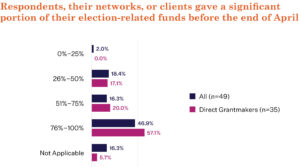
Bar graph titled "Respondents, their networks, or clients gave a significant portion of their election-related funds before the end of April." The chart shows that 57.1% of direct grantmakers, and 46.9% of all repsondents, gave between 76% - 100% of their election-related grants before the end of April.

2. The majority of All by April signers reported that they changed their plans for giving in 2024 because of the campaign.

The campaign’s deadlines and structure created the motivation that moved signers to action – especially among those who were newer to election-related giving. Among direct grantmakers in the survey, 57 percent gave between 76-100 percent of their funding for elections work by April. Those who did not change their giving based on All by April reported that they had already planned to move their funds early or faced internal barriers that prevented them from doing so.

“Once we had our list of grantees, we might have spent more time obsessing over allocation amounts. Having taken the pledge helped inspire us to stop worrying and get the money moving.”
— All by April Participant (Grantmaker)

3. The campaign changed expectations about how philanthropy can support election-related work.

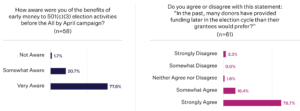
Nearly all of the campaign signers (98%) reported that they were already aware of the benefits of early money for election-related work before the campaign began, but they lacked the motivation and urgency to respond to the field’s need. Signers who were not direct grantmakers, but who advise donors or convene donor networks, reported that the campaign created a “movement wide” framing that gave them the language to encourage earlier giving among their clients and members.

Two side-by-side bar graphs displaying the survey responses to two questions. The first question on the left says "How aware were you of the benefits of early money to 501(c)(3) election activities before the All by April campaign? with 77.6% "Very Aware," 20.7% "Somewhat Aware" and 1.7% "Not Aware." The second question asks "Do you agree or disagree with this statement: 'In the past, many donors have provided funding later in the election cycle than grantees would prefer?' with 78.7% "Strongly Agree" and 16.4% "Somewhat Agree."

“It allowed me to have conversations with peer funders about the importance of moving early. It created a very helpful (even if somewhat artificial) deadline.”
 — All by April Participant (Donor Advisor)

“We used the All by April frame to push our entire donor community for larger, earlier giving, and to make the case for c4 money also. it was helpful to have “movement wide” framing, coordination and momentum to support the work we would have done.”
— All by April participant (Philanthropic Network)

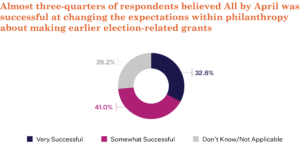
A circle bar graph titled "Almost three-quarters of respondents believed All by April was successful at changing the expectations within philanthropy about making earlier election-related grants." Below is a graph showing 32.8% believed it was "Very Successful" and 41.0% believed it was "Somewhat Successful."

We are grateful to all of the campaign signers who committed to meet the urgent needs of the field when the funds would be most useful. We are especially grateful to the signers who participated in the evaluation and shared their funding data. This transparency allows us all to learn together and continue to improve the way we support free, fair, and representative elections.

Exploring Practices to Move Money Faster

The All by April campaign evaluation revealed that some funders need to make intentional changes to their practices to meet the needs of the field. Funders reported needing to move their timeline for considering new grants or shift other internal processes — like grant amendment requirements — in order to move up payments.

At Democracy Fund and amongst survey respondents, we noted several practices that helped funders move funds quickly:

  • Streamlining the grant amendment process. Funders cut internal red tape and asked that grantees only submit an updated budget to process an amendment.
  • Adopting a shorter renewal application. A shorter application helped to avoid asking grantees to send information their current funders already had.
  • Starting in 2025, planning to default to making payments for election-related grants in Q1 of each year.

Funders may also consider other established time-saving practices like accepting applications that grantees have prepared for other funders or funding intermediaries who may have existing grantee relationships and can regrant money into state and local groups.

Looking Ahead: Funders Need to Sustain the Field Between Elections

Our grantees are on the frontlines of the 2024 election, doing everything they can to ensure it is free, fair, and representative. But we know their work is not over on Election Day. Anti-democracy forces don’t defund their infrastructure after every election cycle, forcing groups to downsize and lose momentum — and we shouldn’t either.

Yet many grantees see a financial cliff after November. This sudden dropoff in funding threatens their ability to resist the authoritarian playbook, fuel a governing agenda, and build durable power in service of creating a more inclusive, multi-racial democracy.

To ensure we are meeting these needs, we will be announcing a new campaign next week, called “Election Day to Every Day” to ensure our pro-democracy field is ready for any and all scenarios that lie ahead in the post-election period. We must keep our foot on the gas and make sure our field partners know that we have their backs not only on Election Day, but Every Day that follows.

Democracy Fund
1200 17th Street NW Suite 300,
Washington, DC 20036