Blog
July 18, 2024

As we head into the presidential election, the pro-democracy movement must meet the moment to strengthen our democracy and ensure equitable participation, voice, and power in communities of color. This work happens on both sides of the ballot box – by increasing voter participation and by supporting election administrators who serve our diverse electorate.

On June 26, Democracy Fund hosted a webinar that focused on the trends and needs in the election administration field, featuring Amanda Litman, Executive Director and Co-Founder of Run for Something Civics and Virginia Kase Solomón, Executive Director of Common Cause Education Fund. The conversation, facilitated by Ebony West, Senior Associate at Democracy Fund, focused on the critical issues surrounding election administration in the United States, including the challenges and opportunities administrators are facing today and strategies to strengthen and diversify election administration leadership.

Since 2020, we have experienced a high level of attrition among election administrators as a result of low compensation, inadequate funding, and a hostile work environment due to growing threats against election administrators. And, despite our country becoming increasingly diverse, many election administration positions are still largely filled by older, white Americans who may be unaware of the challenges faced by marginalized communities in gaining equitable representation and access to the vote. Finally, many states have enacted restrictive voting laws, making the voting process more difficult for people of color, young people, LGBTQ+ people, and people with disabilities. However, thanks to the efforts of our panelists, their organizations, and others like them, we’re seeing inspiring progress to confront many of the challenges facing the election administration field.

One example of Run for Something Civics’ approach is exemplified in the Arizona Pima County recorder Gabriela Casarez Kelly, a member of the Tohono O’odham Nation. Kelly successfully advocated for the reinstatement of early voting sites on the Pasquay Yankee reservation, significantly increasing accessibility and voter turnout. Her journey exemplifies the real-world impact of diversity in election administration.

We also heard about the work Common Cause Education Fund is doing to increase state-level funding for election offices so they have more resources for voter education and operations. In North Carolina, Common Cause North Carolina and Democracy North Carolina successfully advocated for increased funding to the Chatham County Board of Elections so they could hire an IT Specialist. These partnerships between election administrators and advocates are key to bolstering funding for elections so that they are accessible, secure, and responsive to voters.

The field of civil society organizations supporting election officials is small, but mighty. Organizations like Center for Tech and Civic Life, Center for Civic Design, and Public Rights Project are some of the few organizations who provide training and legal support to a field that continues to face an increasing amount of challenges including our ability to carry out a safe and fair election.

While these efforts show hope of a better, more representative democracy, this important work is at risk. The chronic challenge of underfunding in election administration has now been met with new operational challenges posed by escalating security threats. Election administrators are the last line of defense against abuse of power in our government, and their work needs our support.

Our ask is simple. Philanthropy must urgently prioritize long-term investments in the backbone of how our elections are run, election administration. Our support should support the strengthening of the workforce and the systems that make the voting process equitable. Civil society and election administrators must continue to deepen the relationship with each other to ensure we work together to solve the most urgent problems for the long-term health of our democracy.

Op-Ed
Joe Goldman, Laleh Ispahani and Deepak Bhargava
/
March 6, 2024

This op-ed was written by Democracy Fund president Joe Goldman, Open Society-U.S. executive director Laleh Ispahani, and JPB Foundation president Deepak Bhargava, about the All by April campaign, a movement of funders and donors who have pledged to move funds faster this year and support nonpartisan efforts to ensure the election process is free, fair, and representative. Learn more about the campaign at AllByApril.org and read the full op-ed at Inside Philanthropy.

Free, fair and representative elections are difficult to achieve under the best circumstances. As 2024 progresses, the good news is that one of the cornerstones of American democracy — the hundreds of nonpartisan, nonprofit organizations devoted to an inclusive, multiracial democracy — are already hard at work.

They need resources — now.

Nonprofit organizations perform essential election work in our democracy. In communities around the country, organizations help recruit poll workers, organize nonpartisan voter registration drives, combat misinformation, support local election officials and work to ensure that the diversity of our electorate is represented in our election process.

…Many donors do not realize that supporting democracy in an election year requires donations by the spring, not the summer or fall.

Read the full op-ed on InsidePhilanthropy.com.


Featured
/
February 7, 2024

The nonprofit organizations working tirelessly to ensure our elections remain free, fair, and representative are the unsung heroes of our democracy. Whether they are fighting to reduce barriers to voting, combating misinformation, recruiting poll workers, or organizing registration drives, these nonpartisan groups help connect voters to the ballot and protect the integrity of our elections.

Unfortunately, too many of these organizations must head into a challenging environment without the resources they need. Year after year, we hear from the field that donors are moving too slow and that money has arrived too late to be used effectively and efficiently.

Early and consistent resources are key to grantee operations. Supporters need to give them the runway they need — the confidence to plan, the ability to hire and train staff, and the time to lock in lower cost rates. In an era where early and mail-in voting are becoming more prevalent, the need for early resources that support our elections infrastructure is more critical than ever.

No doubt, many of the challenges that nonprofits face are a result of grantmaking timelines and practices. That’s why Democracy Fund, along with dozens of other pro-democracy funders, is making the All by April pledge. We’re committing our dollars earlier and moving funds sooner than we might have otherwise. Already, more than 70 foundations, individual donors, philanthropic advisors, and pooled funds have signed the nonpartisan, 501(c)3 All by April pledge.

Our commitment is straightforward. We are working to be good partners to our grantees and doing all that we can to have their backs as we head into another election cycle.

As part of Democracy Fund’s pledge, our teams are expediting the disbursement of funds to our election-related grantees by the end of April. This means making grant commitments, payments, and disbursements of multiyear grants earlier in the year than we sometimes have in the past. We’ve also been doing what we can to streamline processes, especially for renewal grants, and providing general support grants as much as possible. These actions, we hope, will equip nonprofits with the financial support they need well ahead of the election that they are seeking to protect.

Sign on to the campaign at AllByApril.org.

Many donors are joining us in committing to make all or most of their grants by the end of April. Others are focusing on streamlining renewal processes or finding alternative ways to support their grantees. I hope that even more of my peers will join us in adopting these practices and fostering a collaborative approach to strengthen our democracy. This campaign won’t solve all the funding challenges our civic groups are facing, but I hope it’s a good start.

At a time when our republic is in such a precarious position, philanthropy can no longer conduct business as usual. Creating a culture of early and expedited funding for organizations seeking to ensure free, fair, and representative elections is a tool in our arsenal that directly addresses systemic challenges to our democracy. I invite you to join me in this commitment, ensuring that pro-democracy organizations have the resources they need to fortify the foundation of our democratic system.

Announcement
February 1, 2024
Blog
/
January 11, 2024

Ten years ago, Pierre Omidyar and I launched Democracy Fund and Democracy Fund Voice after a three-year incubation inside Omidyar Network. The world has changed a lot since then, and so have we.

Over the past decade, Democracy Fund and Democracy Fund Voice have committed $425 million in grants to strengthen American democracy. In that time, we have evolved and grown in our understanding of the perils facing our country and the importance of racial justice as fundamental to our work. We believe that achieving an inclusive multiracial democracy means we must fight for our democratic values now — while pursuing transformative changes that can unrig our political system.

As we enter the 2024 election season, the challenges in front of us are sobering. Despite overwhelming evidence of the dangers posed by authoritarians, new Democracy Fund research shows just how easily Americans will accept undemocratic actions if it benefits their side. While our grantees have worked to ensure consequences for those who tried to undermine our free and fair elections in 2020, the authoritarian threat has not subsided.

Today we face a set of challenges that create profound uncertainty about the future of our republic. The pro-democracy field cannot afford to allow ourselves to be overwhelmed by the high stakes or range of threats. We’ve risen to the moment before and we can do so again.

Democracy Fund and Democracy Fund Voice are focused on ensuring the field is prepared and resourced for the challenges that may emerge before, during, and after the 2024 election cycle:

  • We are working on protecting free and fair elections by shoring up election administration.
  • We’re fighting back against mis- and disinformation.
  • We’re strengthening accountability systems for authoritarian abuses that could come in 2025.
  • We’re also calling on our peers to join us in making their nonpartisan election-related grants by April, so that groups have the resources they need in time.

While we stand up against urgent threats, we continue to pursue transformative change toward a political system that is open, just, resilient, and trustworthy. This work is complex and challenging, but innovators and advocates continue to make steady progress and real strides toward transformation.

For example, a decade ago, Democracy Fund began responding to warning signs that local journalism was under threat. The sector was seeing layoffs, newsrooms collapsing, racism and sensationalism were all too common, and communities were being left with little or no trustworthy reporting. Together with our grantee partners, however, we saw in this crisis an opportunity for reinvention. We saw the promise of promoting new business models and centering the voices of communities who were never well-served by traditional journalism. Today there is a growing and thriving landscape of non-profit journalism. A tremendous community of news innovators, including our grantees, have created a new way forward for civic journalism. It’s taken years of patient investment to build from a ripple to a wave — but today we see the wave.

This past fall, funders made a new commitment to scale these approaches. Democracy Fund and a coalition of 20 funders announced plans to invest more than $500 million into local news and information over the next five years. We see this as a down payment toward an even more ambitious vision to reimagine the place of local news in the life of communities and our democracy. Local news will never be what it once was, but Democracy Fund grantees have had the vision to rebuild it as something better. The work ahead of us, in journalism and across our democracy, will take more collective action like this.

Exactly what lies at the end of 2024 is uncertain, but with a clear focus on resourcing, mobilizing, and expanding the pro-democracy movement, our field can navigate the year. It is also the time to work with resilience and purpose on advancing the promising ideas that may grow to be the next wave of change for our democracy.

Blog
/
November 2, 2022

In a nation of over 258.3 million eligible voters, election officials’ myriad duties differ from jurisdiction to jurisdiction—small to large, rural to urban—and from voter to voter. Despite these many differences, there are common themes and predictable challenges faced by every official. And of course, every official has experienced unforeseen events and unexpected circumstances that force them to assess, reform, and adapt. As any official will tell you, there is always another election on the horizon. 

The Democracy Fund/Reed College Survey of Local Election Officials provides a window into the attitudes, actions, and needs of the public servants who manage US elections. Surveys during the last three election cycles have illustrated the stable features of the system and the way that the challenges of the moment impact the people administering the democratic process.  

Local Election Officials

More than half of election officials are elected – 57 percent overall, but in small jurisdictions with fewer than 5,000 registered voters that increases to 67 percent – while 27 percent are appointed, and 15 percent are hired to fill a position. Just over half of these races are partisan and the other half are non-partisan, and the vast majority of elected officials (81 percent) ran uncontested in the general election. The need to attract candidates and talent will only continue to grow as veteran officials leave the field in growing numbers. 

In the 2018 survey, officials’ recent experiences with foreign interference in election cybersecurity impacted the complexity of their work. In 2020, the pandemic and extraordinary polarization of the candidates and the electorate created stress and rapid change in methods of voting that election officials had to manage. The 2022 survey illustrates more emergent challenges as election officials report coping with the combinations of mis- and disinformation about elections, violence against election officials, and extreme partisan disparities in the public’s confidence in election results. 

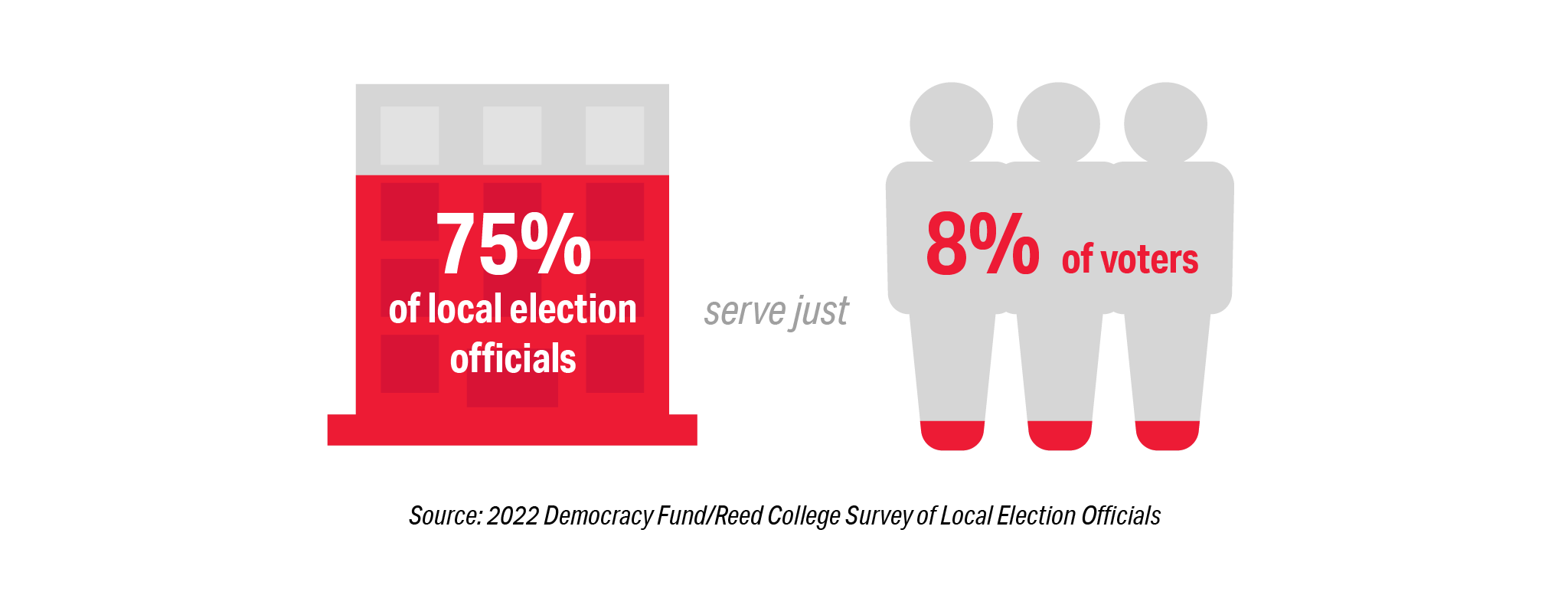
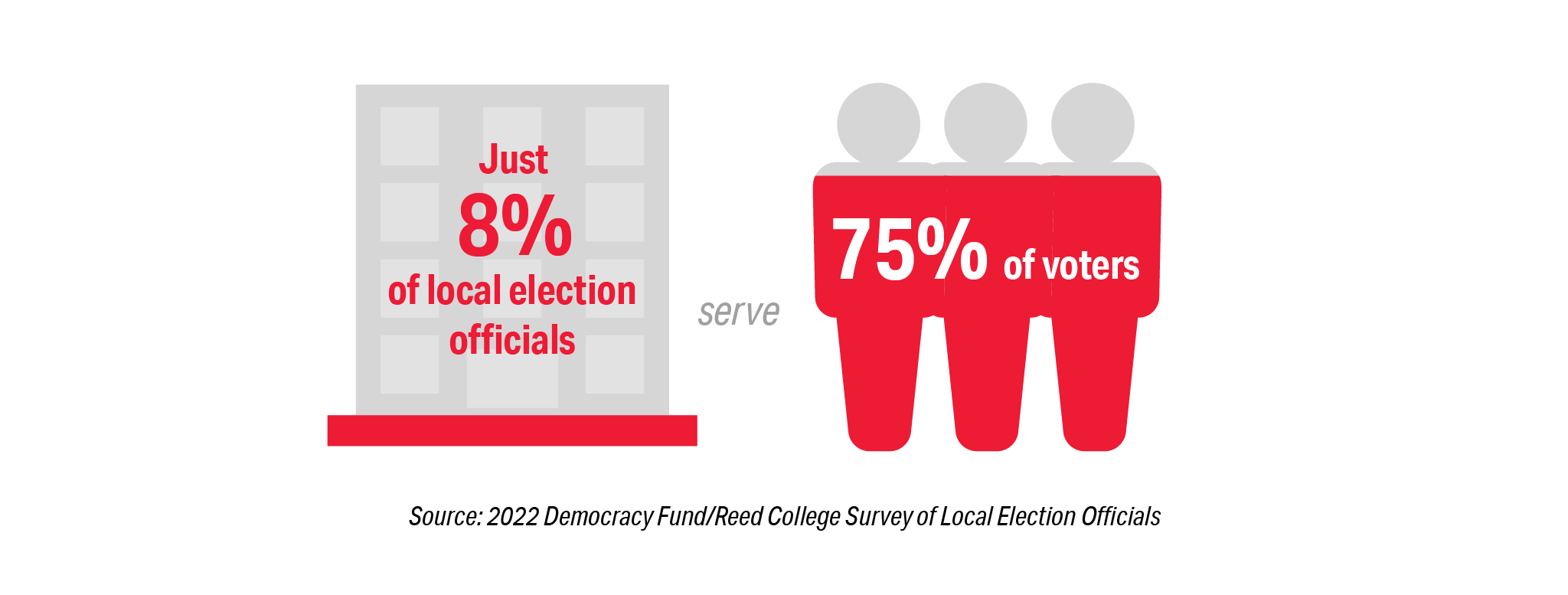
All of this is happening in an environment where the biggest disparity in the election system continues to be geographic. Elections are managed by local jurisdictions and there are tremendous differences between election offices that serve the largest and smallest populations. Seventy-five percent of all offices serve only 8 percent of voters, and 8 percent of our election offices serve 75 percent of voters. This disparity is driven by the fact that the largest 2 percent of offices serve half of the nation’s voters.  

Graphic of building and people stating that 75% of local election officials serve 8% of voters

Graphic of building and people stating that 8% of local election officals serve 75% of voters


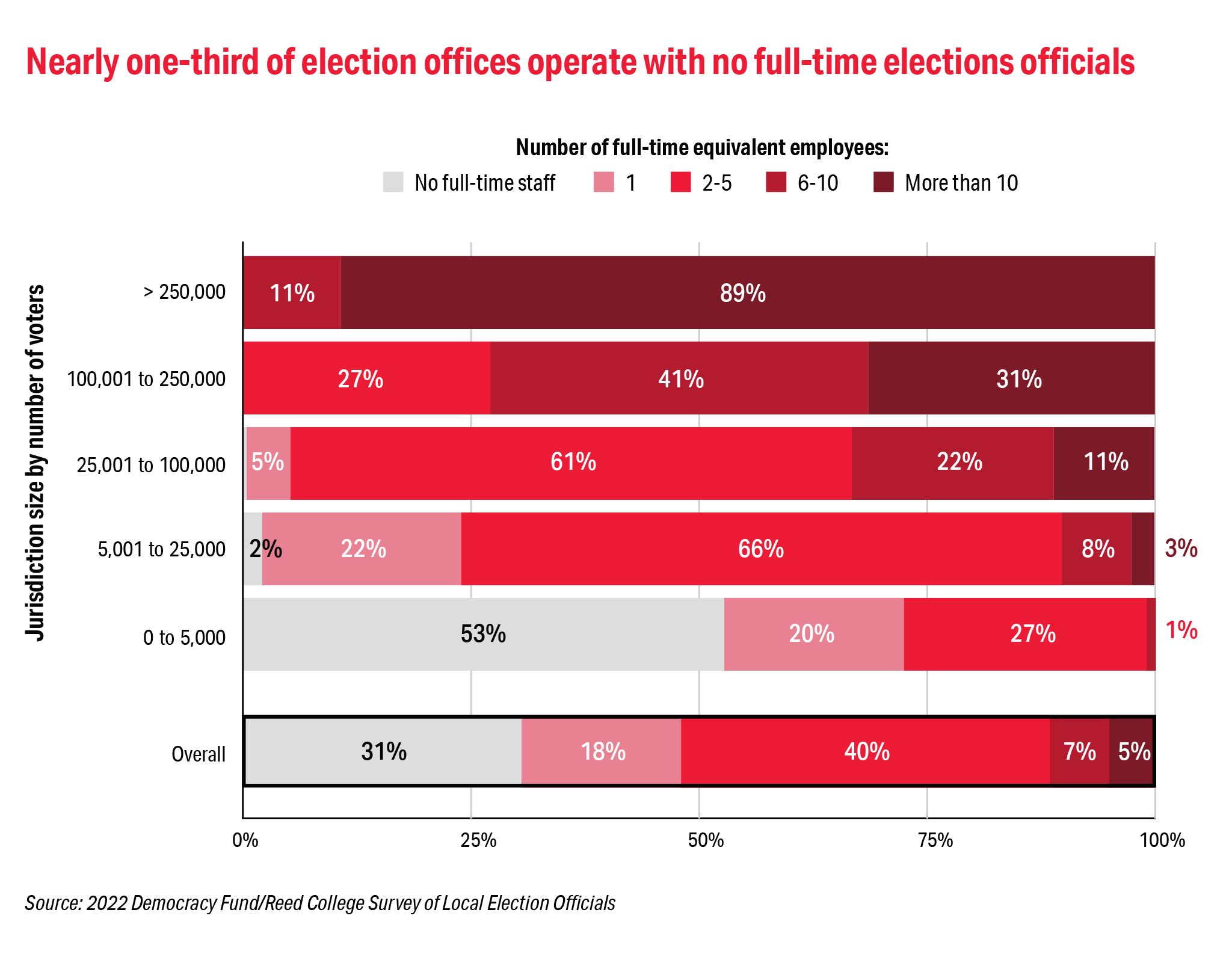
The impact of an increased election-related workload is disproportionally higher on smaller jurisdictions than their counterparts in medium and large jurisdictions. This should not be surprising since one third of all election offices do not have even one full-time employee. In small jurisdictions that serve less than 5,000 voters that number increases to 53 percent. The increased workload for many may have been the result of concerted campaigns to flood election offices with Freedom of Information Act requests around the 2020 election based on conspiracy and conjecture. 

Graph of different jurisdiction sizes by number of voters showing that nearly one-third of election offices have no full-time elections officials.

Each election cycle, the Democracy Fund/Reed College Local Election Official (LEO) Survey has asked local officials about key aspects of their work including preparedness for the upcoming election, job satisfaction, and training needs for the election officials and members of their staffs. 

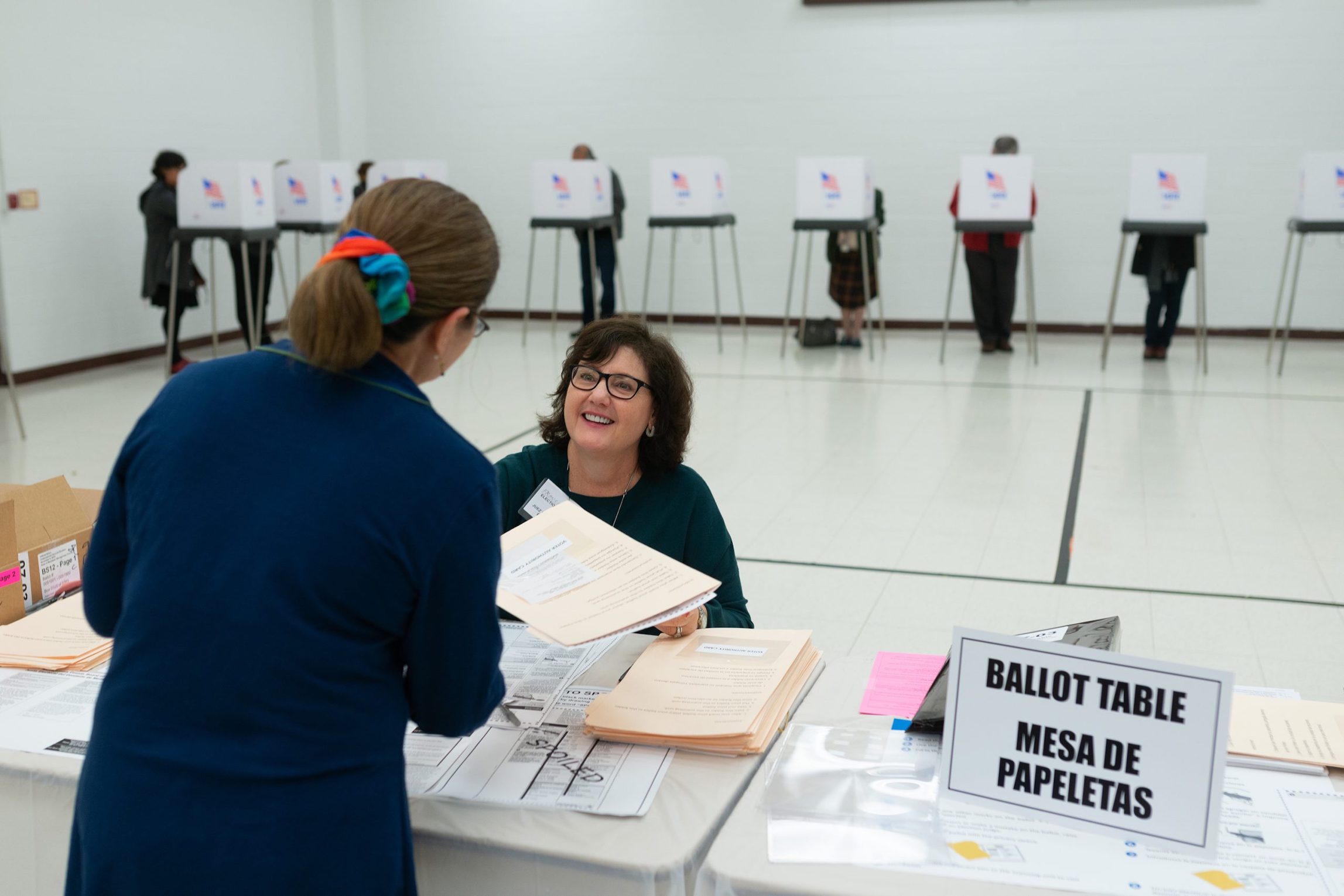
LEOs retain a commitment to meeting the demands of their jobs and the challenges of finding adequate polling locations and poll workers – especially sufficient bilingual workers and accessible facilities – persist with varying degrees across jurisdiction sizes.  

Overall job satisfaction among LEOs remains high, but there are cracks in the veneer. The percentage of LEOs who do not think they can maintain a work/life balance has increased and the percentage who say their workload is reasonable has dropped since 2018. 

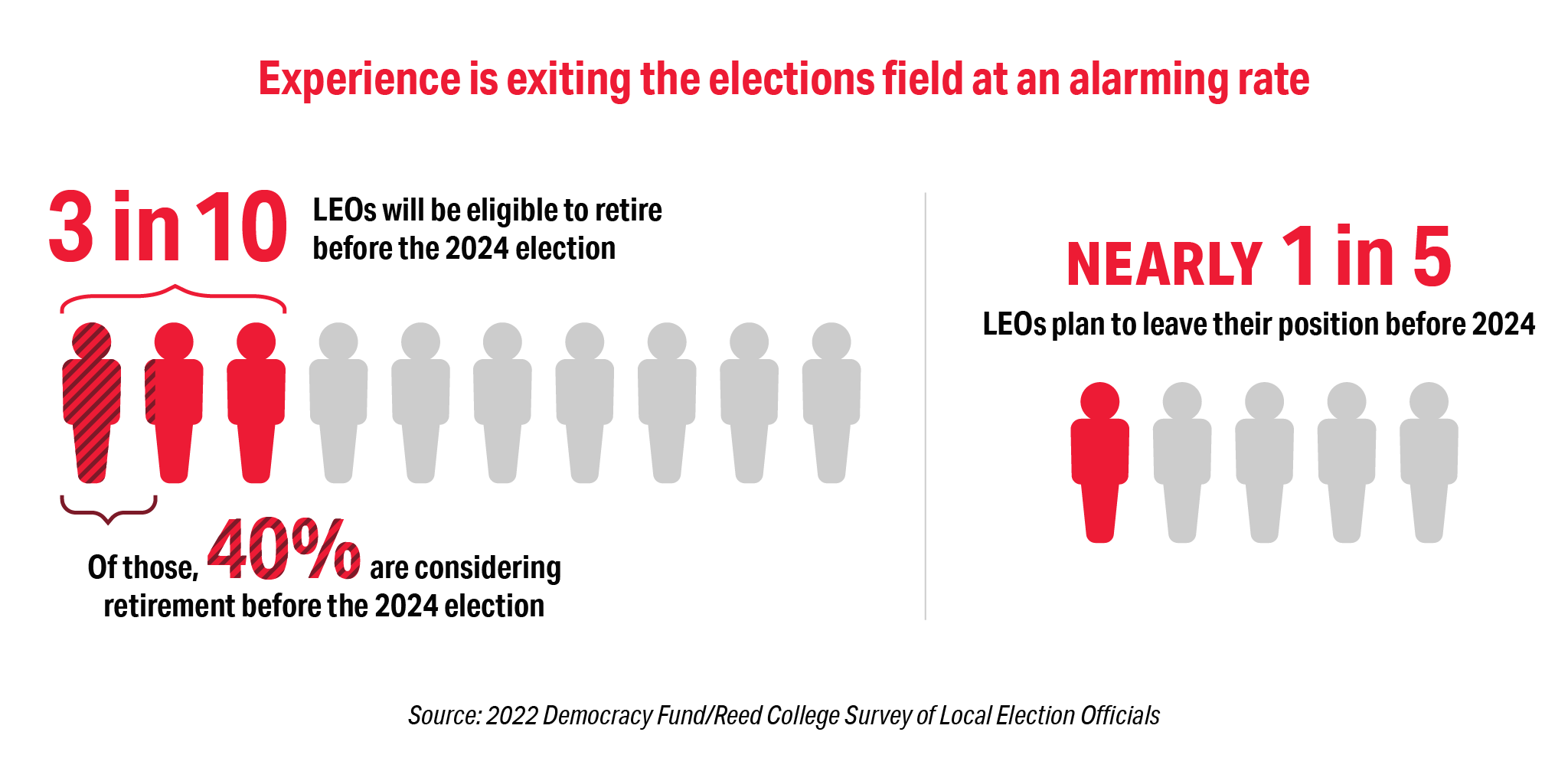
Graphic showing 3 in 10 local election officials will be eligible to retire before the 2024 election and that nearly 1 in 5 plan to leave before 2024.

Among the 2022 survey participants, close to one third of the election officials are eligible to retire before the 2024 election—and 39 percent of those eligible plan to do so. Of these respondents, retirement eligibility is the highest reason for leaving the field (51 percent) but “I do not like the changes in my work environment that occurred during and after the November 2020 election” (42 percent) and “I do not enjoy the political environment” (37 percent) followed close behind. For those who are not near retirement age their number one reason for leaving the field was cited as “changes in how elections are administered make the work unsatisfying” (48 percent) and an alarming 28 percent citing that they plan to leave the field based on “concerns about my health or personal safety, aside from COVID concerns.” 

Disruption in the Field

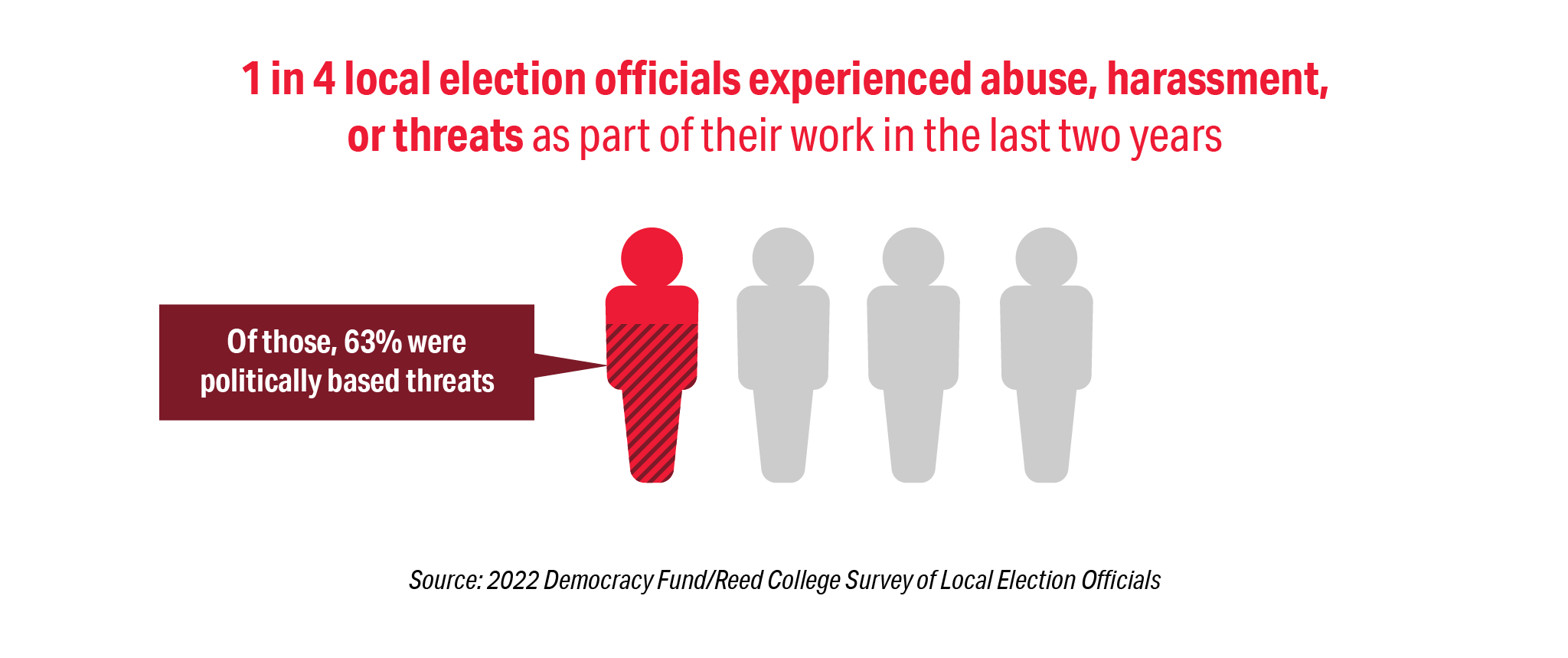
One in four respondents have experienced threats of violence. Officials across all jurisdiction sizes and political affiliations experienced these threats, but the threat environment is much more severe in larger jurisdictions compared to smaller jurisdictions. For example, while 14 percent of LEOs serving jurisdictions with less than 5,000 registered voters told us that they had experienced abuse, harassment, or threats, the percentage increases to two-thirds of LEOs serving in the largest jurisdictions. Similarly, 20 percent of LEOs who told us they were Republicans said they experienced threats, compared to 30 percent of Independents and 34 percent of Democrats. These differences should not disguise the overall result: threats against LEOs are far too real, far too regular, and far too common.

Graph stating that 1 in 4 local election officials experienced abuse or threats as part of their work in the last 2 years. 63% were politically-based.

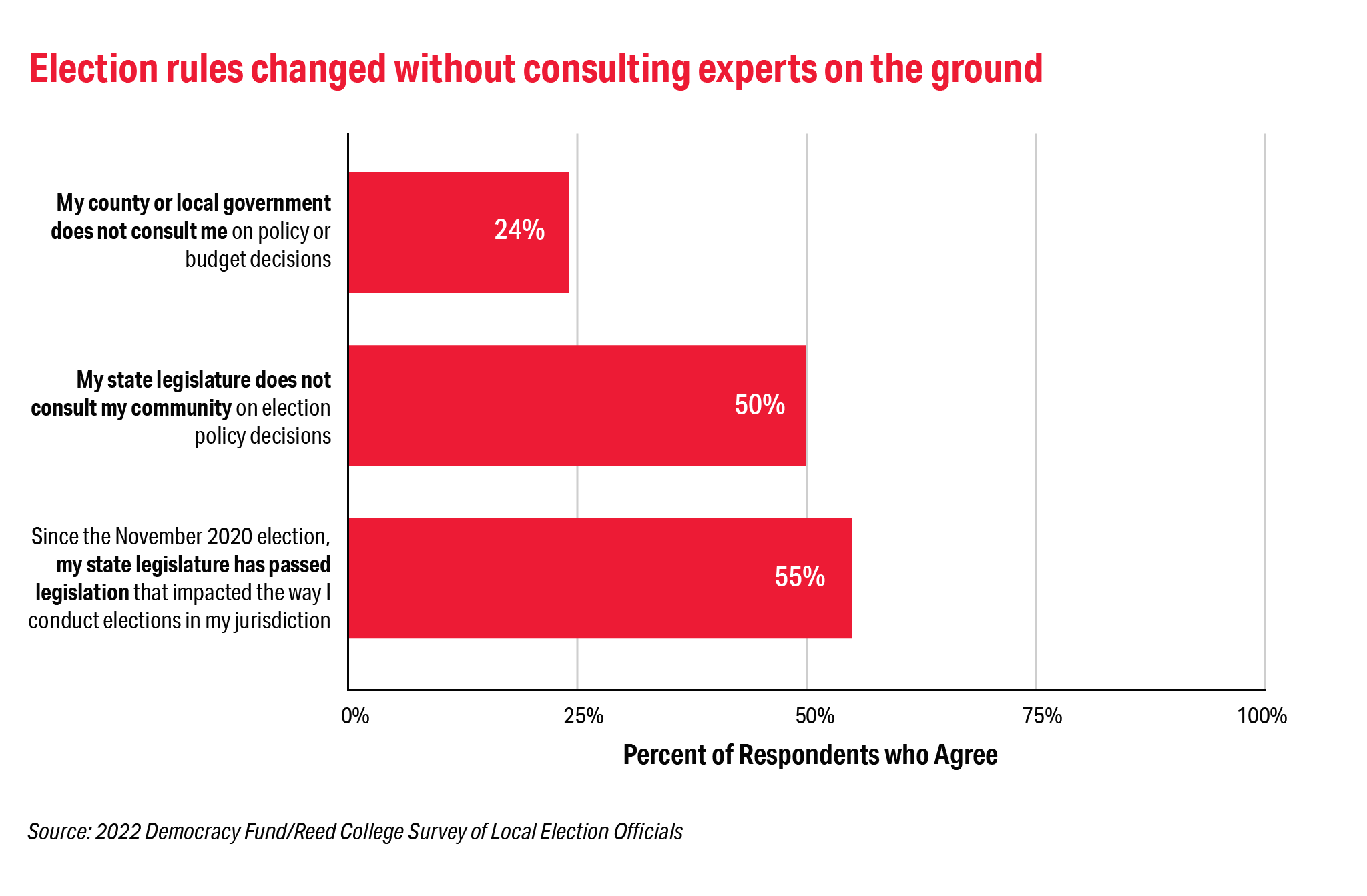
The preponderance of threats targeting election officials are politically based threats. Our 2022 survey showed that 63 percent of threats received were politically motivated. The narrative driving these threats—that the 2020 election was illegitimate and that LEOs were complicit in allowing the election to be stolen–-has manifested in threats to election professionals and their families, and changes to state election laws. More than half (55 percent) of the survey respondents said that they have had legislation passed that impacts how they conduct the election—with 35 percent saying those changes improved election administration and 46 percent saying the new laws did not improve election administration.  

Graph stating: 24% of LEOs said they were not consulted on policy decisions. 50% said their community was not consulted, 55% said policies were passed that impact election administration.

The majority – 66 percent – of election officials surveyed this year expressed concern about threats and harassment. When asked how seriously various organizations take the threats to election officials, 43 percent said that their state’s chief election official (in most states, the secretary of state) takes the threats “very seriously.” However, LEOs felt that others took the threats far less seriously: only 27 percent for local law enforcement, 25 percent for federal law enforcement, 17 percent for the state legislature and for the national media, 14 percent for the local media, and 12 percent for the U.S. Congress.            

About the Survey and Interviews

The 2022 survey of local election officials was a self-administered web and hardcopy survey conducted from June 21 to September 22, 2022. This study used a LEO sample collected by the team, with a sampling frame based in part on national lists of local election officials and the sizes of their jurisdictions. From this frame, the team drew a sample of 3,118 LEOs, sampling jurisdictions in proportion to the number of registered voters they serve and targeting the chief election official in each jurisdiction to complete the survey. A total of 912 LEOs completed the survey, including 652 surveys completed via web (71 percent) and 260 (29 percent) completed via hardcopy with an overall response rate of 30 percent.   

Survey findings are often presented by jurisdiction size to understand differences in experiences. 

  • Fifty-seven percent of local election officials serve in jurisdictions of 5,000 or fewer voters. 
  • Twenty-seven percent serve in jurisdictions of 5,001 to 25,000 voters. 
  • Ten percent serve in jurisdictions of 25,001 to 75,000 voters. 
  • Six percent serve in jurisdictions of more than 75,000 voters. 

While most officials serve in small jurisdictions, the vast majority of voters live in large jurisdictions — over 70 percent of voters live in jurisdictions with more than 75,000 voters and are served by only 500 officials. It’s important to consider the possible differences in scale, responsibility, and resources between different jurisdiction sizes when interpreting results from any survey of this population. Where overall results are presented, they are weighted to ensure that means can be generalized to local election officials nationwide. Further information about the sampling and weighting process is available at the Reed College Elections & Voting Information Center’s project website.  

Explore additional 2022 content and learn more about the Democracy Fund/Reed College Survey of Local Election Officials through Reed College’s Elections & Voting Information Center. Prior publications from the survey series are also available below.  

Report
July 29, 2022

In the fall of 2021, Democracy Fund commissioned an evaluation of our Election Security and Confidence portfolio – the major focus of the Elections & Voting Program’s Trust in Elections strategy – to summarize our investments, activities, and impact and help us make informed decisions about future investments. Here, we reflect on the history of our election security work and share key findings from the evaluation. For a deeper dive, we invite you to read the full report.   

History of the Election Security & Confidence Portfolio

The 2016 U.S. Presidential Election was a turning point for election security following attempts by foreign actors, namely Russian, Chinese, and Iranian groups, to disrupt the election with cyber-attacks. After the election, as information surfaced about how foreign actors scanned – and in a few cases gained entry into – several state and local election networks, it became clear that election security was now a national security concern. In response to these events, the Democracy Fund Elections & Voting Program added a body of work in 2017 to focus on improving security and confidence in our elections. With an emphasis on election security, this portfolio aimed to fortify the election system to prevent further foreign interference and counter cybersecurity threats by investing in tools and training for election officials. As part of these efforts, we also launched the Election Validation Project, which focused on expanding the use of post-election audits, and Democracy Fund Voice supported coalitions that advocated for, and secured, federal funding for elections in three straight years – 2018, 2019, and 2020 – which was the first funding for elections since the passage of HAVA in 2000. 

The Elections & Voting Program’s initial landscaping and research led to the development of four core areas for grantmaking to prevent election interference based on the threats posed by foreign actors and vulnerable security infrastructure. These core grantmaking areas included: 

  • Fortifying the field with workable solutions and best practices 
  • Empowering election officials to advocate for funding to strengthen election cybersecurity 
  • Researching verification practices and resiliency efforts 
  • Public messaging on the legitimate risks to election systems 

Evaluating the Portfolio’s Impact

An evaluation of the portfolio’s impact, conducted by Fernandez Advisors, focused on identifying the impact, growth, and sustainability of our investments to improve both election security and confidence in election outcomes. The report found that our investments in election security resources and tools that increased the capacity of state and local election administrators to identify and manage security threats were among the most valuable. In particular, government agency partners noted the critical role that Democracy Fund played by acting quickly and early to take the financial risks necessary to develop and pilot new election security resources (e.g., trainings, tools, technical assistance, and playbooks), which were eventually adapted by local, state, and federal government agencies once the proof of concept had been established.  

Our early investments in election cybersecurity contributed to the successful execution of the 2020 election. These investments in enhancing election cybersecurity through training and tools and the push for additional federal funding for elections helped create the conditions for what the U.S Department of Homeland Security called, “one of the most secure elections in history.”  

Summary of Findings & Key Takeaways

Despite our work on election security and cybersecurity, public trust in the election system is dangerously low. When we started our work in election security, we believed that investing in election cybersecurity would protect the system from foreign interference, which would lead to increased public trust in elections. The first part of the hypothesis proved accurate—states and the federal government have adopted many of our grantees’ election cybersecurity training and tools, freeing election officials to turn their attention to other issues in the system. However, hyperpartisanship and threats of authoritarianism have further reduced public trust in elections and – in ways that were simultaneously unexpected and should have been anticipated – exposed new elections vulnerabilities including viral mis-and dis-information, the spread of unproven ballot review techniques, and attacks on election officials.   

When we began investing in election security, it was still a young field with few philanthropic players. Democracy Fund played a role in catalyzing new approaches to improving election security, many of which are now embedded in the election system and the work of election officials. The 2016 election was a wake-up call that exposed the security vulnerabilities of our election system, and the system responded by shoring up the infrastructure. We are proud to have played a role in that initial response, and still believe that a resilient system is essential to ensuring free, fair, and equitable elections in this country. 


Report
/
July 28, 2022

From its inception, Democracy Fund has invested in organizations supporting election administration. We believe that well-functioning election operations are a core component of a healthy election system. At the end of 2021, we commissioned an independent evaluation of the Elections & Voting Program’s Voter Centric Election Administration portfolio to review how our theory of change was executed and how the election system has shifted. Here, we reflect on the findings from that evaluation and invite you to read the full report.  

Voter Centric Election Administration Portfolio History

The landscape of election administration in 2014 is a far cry from what we experience today. At that time, the findings of the Bipartisan Presidential Commission on Election Administration were widely praised and pointed the way toward evidence-based solutions to election challenges – such as long lines at the polls and errors on voter lists – that made use of developments in technology. Election administration has always been complicated, especially in the highly-decentralized U.S. system. However from 2014-2016, the field experienced clarity of purpose and a relatively-uncontentious bipartisan consensus on best practices to move the field forward. 

In this context, Democracy Fund developed a theory of change that focused on two needs of the field:

  1. Strong networks of election administrators for knowledge-sharing across and within states
  2. Innovative practices and technology designed for election administrators to use. 

To meet the first need, we identified the leaders of state election administrator associations and hosted convenings with them twice a year in a “train the trainer” model, whereby they would learn best-in-class practices to take back to their state associations of election officials. For the second need, we invested in a wide range of civic technology tools, research, and guides developed by civil society organizations that could be used by administrators to better serve voters. Our goal was to scale and spread practices that would improve the voting experience nationwide.  

Evaluation of the Portfolio’s Impact

An evaluation of the portfolio’s impact, conducted by Fernandez Advisors, focused on the ways that election officials at the state and local level have engaged in Democracy Fund’s network convenings and used tools, training, and resources in which we have invested. The report found that investing in tools and resources for election administrators helped the field adapt to shifts in voter expectations for online services and new voting methods. Our grantees’ programs helped to improve the design of election websites and ballots, helped administrators adapt to early voting and mail voting policies, and helped voters learn where to find a polling place or ballot drop box easily and accurately. These are just a few examples of the ways our grantees supported administrators’ efforts to serve voters.  

This portfolio was especially well-timed to meet the unusual needs of the 2020 election when many states rapidly adjusted their voting policies and practices to respond to the COVID-19 pandemic. Many states offered voters more flexibility to vote early at home or at voter centers in order to avoid crowds at Election Day polling places. These states could not have rapidly adopted new voting methods without following the examples of states that had spent years innovating and experimenting with flexible voting practices. Democracy Fund grantees were instrumental in helping states learn quickly from these examples because they had documented implementation processes and offered technical assistance. 

While network-building, tools, and research have been instrumental in improving election administration, the failure of local and state governments to adequately resource election offices remains a significant problem. Significant and ongoing technology changes (such as online voter registration and ballot tracking) present adoption challenges for many election administrators and their staff due to both the lack of funding for technology investments and maintenance and the difficulty covering the range of expertise needed with the very small staffs that manage elections in all but the largest jurisdictions. For example, election officials interviewed for the evaluation report that they do not have the capacity to counter growing mis- and disinformation targeted toward voters. 

The job of managing elections has grown increasing complex as the field faces new challenges. Local election officials must be experts in many areas: human resources, information technology, direct mail processing, public relations, cybersecurity, and more. Most election officials are managing this load with little staff capacity. In the 2020 Democracy Fund/Reed College Survey of Local Election Officials, over half of respondents said they work in an office with just one or two staff members who may not even be full-time. Participants in Democracy Fund’s state association convenings praised the information and opportunity to share knowledge and resources with peers from other states and bring ideas back to their colleagues. However, limited staff capacity and urgent demands makes it difficult for many officials to spend time adopting new practices.  

Summary of Findings & Key Takeaways

When Democracy Fund began investing in civil society organizations focused on election administration, it was still a young field, with limited philanthropic investments supporting the work. We used a systems and complexity approach to analyze the needs of the field and identify the gaps and leverage points that could improve the health of election administration. We played a role in catalyzing new nonprofit organizations that support election officials and in funding emerging election sciences research. The COVID-19 pandemic upended the 2020 primary elections and made evident the importance of well-resourced and well-functioning election administration. In response, the field of organizations supporting election administration scaled up as more donors began funding this work. Even as the context shifts over time and the field adapts, strong election administration is essential to the health of a just and equitable election system.  


Resource
February 17, 2022

Removing Language Barriers from the Voting Process

Democracy Fund’s Language Access for Voters Summit is an annual event that aims to remove language barriers from the voting process. The 2021 convening was held Dec. 13-14, 2021, following the Dec. 8th release of the Census Bureau’s new Section 203 language determinations under the Voting Rights Act—which provide language assistance in U.S. elections.

To help election officials navigate and implement the necessary changes, the agenda included discussions with local, state and federal election officials, voting rights advocates, and translation experts. Participants shared pragmatic ideas, tools, and best practices for providing language assistance—focusing officials’ immediate needs in the lead-up to the 2022 midterm elections.

Celebrating the Diversity of Languages in the United States

The two-day event featured a collection of speaker-submitted videos in Armenian, Bengali, Dine’ (Navajo), English, Korean, Mandarin, Spanish, and Yup’ik. These represent a small sample of the languages election officials provide voter assistance for across the United States.

Speakers read the 2020 Presidential Election ballot in various languages from their jurisdictions, highlighted the critical value of language and culture integration in formal settings like polling places, and shared personal stories of how language access has played a role in their own life or someone they love.

The topics, presentations, materials and resources for each day of the Dec. 2021 summit can be viewed and downloaded below.
Blog
Paul Gronke, Paul Manson, and Heather Creek
/
June 17, 2021

Part of “Stewards of Democracy,” a series on findings from the 2020 Democracy Fund/Reed College Survey of Local Election Officials

In the wake of a historically competitive and challenging election, election administration and administrators continue to be flashpoints of political conflict. We want to provide a forward-looking, proactive agenda to sustain this critical part of our democracy and to support the people who serve in more than 8,000 voting jurisdictions nationwide.

For the past six weeks, we have been posting the results of the 2020 Democracy Fund/Reed College Survey of Local Election Officials as part of a “Stewards of Democracy” project. In this final post, we reflect on top takeaways from the 2020 survey and identify paths forward to support and advance the professional community of local election officials.

Here we identify key areas we believe should be a focus for state and local officials and their allies in the policy and research communities. For each, we describe what we have learned from the research as well as where we know we still have a lot to learn — critical questions that call for further experimentation and evidence.

Sustainability Advancement

What we have learned

Local election officials are a community invested with the responsibility of maintaining a piece of critical national infrastructure and administering elections for nearly 240 million eligible voters, yet they report chronic underfunding, a stressful work environment, and rapid and sometimes unexpected policy changes. Local election officials tell us that state and federal lawmakers seldom consult with them when contemplating changes in election administration.

It is vital to identify sustainable budget paths so that local election officials are not constantly faced with new and changing mandates without the resources to meet them. Local election officials are experts and should be consulted as key stakeholders in discussions of the budgets that impact their capacity, as well as legislative and policy decisions related to election administration.

Opportunities for experimentation

Adequate budgets don’t completely solve for the stress and unpredictability of election work. Sustainability also depends on ensuring sufficient and capable staff, which merits attention to recruitment, training, and retention.

Our survey results highlight the importance of professional development and training for election officials. Most officials have access to training when they begin their careers and even more receive ongoing training, but there is variation in officials’ perceptions of how effective that training is. For example, local election officials from the largest jurisdictions are the least satisfied with the effectiveness of their training.

This indicates an opportunity for differentiation in the way training is designed and delivered. To do this well, we need more experimentation in the types of training programs that are offered to election officials and the way those trainings are tailored to the needs of different jurisdictions. Experimentation would allow us to collect new evidence about the kinds of training programs that work best for a diverse and heterogeneous elections administration community.

Where we need more research and learning

The Democracy Fund/Reed College Survey of Local Election Officials provides data on the career backgrounds of the chief local election officials, how long they stay in the field, as well as their job satisfaction and what motivates them to continue doing this work. But we lack data on the staff in local election offices. This would be harder data to gather in a systematic and generalizable way, as our survey does with respect to chief officials, but studying elections office staff would fill in a missing part of the story on diversity, retention, and institutional knowledge in the profession.

Related, we know very little about the recruitment strategies and pipelines used by local election officials to attract staff, what kind of movement occurs across jurisdictions, and whether there are successful diversity initiatives that can serve as object lessons for the elections administration community. As we learn more about diversity in the field, we will have an opportunity to observe how diversity impacts the attitudes and practices of election administrators.

We have heard much this year about a wave of retirements, but we actually know next to nothing about historical rates of retirement and turnover. This makes it impossible to know if we are experiencing a brain drain or just a typical spike that occurs after a presidential year.

And while 60 percent of local election officials across the country are elected to their positions (rather than hired), we know almost nothing about how the elective path operates, and how much turnover is a result of election losses.

Networks and Community

What we have learned

Networks, both formal and informal, and “community” were mentioned again and again in responses to our survey and in our in-depth interviews as ways that local election officials learn, adapt, and maintain resilience in the face of change.

We are convinced that there is a substantial added value to regular state and regional association meetings and venues for professional development, such as Election Center and the election administration program at the University of Minnesota’s Hubert H. Humphrey School of Public Affairs. Not only do local election officials learn in these venues, but they also connect and build support networks. States and localities need to provide budgetary support or other mechanisms so that all election officials, not just those from larger and well-funded jurisdictions, can attend regular training and regional and national gatherings.

Opportunities for experimentation

While we know that networks and community are important, we need to learn more about what structures, events, and learning opportunities are cost-effective and add the most value.

State associations are highly rated as sources of information by most of our survey respondents, but these associations operate very differently from state to state. This variation provides an opportunity to learn how different ways of organizing and creating communities of local election officials produce different levels of engagement and satisfaction among members.

Our survey responses demonstrate that officials in smaller jurisdictions are far less likely than those in medium and large jurisdictions to attend a regional or national gathering of election administrators. Some national programs — such as the ELECTricity, a newsletter run by the Center for Tech and Civic Life — gear their information and outreach toward officials in small and medium jurisdictions. As these programs mature, and new networks are developed, there will be an opportunity to learn about the tactics that bring these officials into the community and how information is shared across the field.

Where we need more research and learning

Interviews with local officials indicate that many of these public servants are connected to other professional networks outside of the elections field. Only 61 percent of local election officials — and 46 percent of those in the smallest jurisdictions — say that elections make up the majority of their workload. Even those who spend most of their time on elections often have other responsibilities, like administering courts, maintaining public records, and issuing marriage licenses. These duties connect them to other functions of their local government and other state and national networks. There is an opportunity to understand how trends in other sectors of local government may impact the work and culture of local election administration.

Voter-Centric Practices

What we have learned

The 2014 report of the Presidential Commission on Election Administration highlighted the importance of a “voter-centric” service orientation among election officials. Respondents to our surveys expressed overwhelming support for a voter-centric approach. Officials, without respect to jurisdiction size, embraced voter education and outreach as part of their jobs. This is good from a customer service perspective and also from a democracy perspective.

But there are barriers to such voter-centric practices: The most commonly cited among these is insufficient budgets for voter outreach. Local election officials must be able to meet voters where they are — whether through print materials, media advertisements, or engagement on social media — and these efforts take time and resources, and may require new skill sets.

Opportunities for experimentation

Our surveys show that some pro-voter policies, such as voter registration modernization, are more likely to be supported by officials who have experienced those policies. This may mean that local election officials who have experience with effective policies can be “champions” to others in the community who have less experience.

However, we don’t know how attitude change occurs among local election officials. Our finding about officials supporting a policy with which they have experience may reflect learning that happens through interactions with a policy — or, it may be acceptance. For example, officials in states that do not currently have a policy may simply be resistant to change, while officials in states that have already implemented a policy have already adapted to the change and accepted a new norm.

Where we need more research and learning

In our post about local election officials’ perspectives on election policy and practice, we noted that the opinions of these officials show some of the same partisan patterns that are observed in the general public. What we don’t know is why these patterns persist in a community of experts that presumably should be more resistant to misinformation and false claims.

More research needs to be done to understand the underpinnings of local election official attitudes toward election administration at a local, state, and national level, and how the structure of beliefs can impact the ethos of election administration. We also know very little about who are the trusted communicators within the community, whether fellow local election officials, state officials, national taskforces, academics, or advocates. Understanding who can best convey information to these local officials is a critical element in advancing a voter-centric approach.

While there is much to explore and learn about the field of local election officials, what we know already points to important ways we can better support the essential work they do in service to democracy and the voting public in their communities.

We encourage fellow researchers, policymakers, and others who care about representative government to be part of this journey of inquiry, knowledge-sharing, and reform. And just like legislators, the research and advocacy communities must engage local election officials in an ongoing and systematic way to ensure we’re asking the right questions and surfacing valuable insights. Local election officials have a critical vantage point, and their voices and expertise should always be part of the conversation.
Democracy Fund
1200 17th Street NW Suite 300,
Washington, DC 20036